Showing posts with label Hodas Setting. Show all posts

Tuesday, May 5, 2026

Blog d100: Superstitions

 Continuing the Blog d100 series laid down by Buster!


Rolled 54: Common Superstitions in your setting

 So with Hodas I've been letting the players coming up with the superstitions in the regions they play in. They continue to build the world around themselves even after the game of wasteland has been completed years ago. So I'm gonna offer you one from each group of the races decided as the major people in Hodas.


Goblins: When someone dies, you open all the doors and windows to allow the spirit to escape the building. This has resulted in significantly less spirits among goblins in a setting where spirits are relatively common. 

Featherfolk: It is bad luck to directly hand someone a weapon. This means that featherfolk, who make most of the guns, set them on the counter before selling. They toss them short distances in combat. Some wealthy merchants will have a statue that is meant to be a middle person between the buyer and seller.

Kobolds: Lava is evil and seeks to consume kobolds, wearing it's colors is unlucky. They live mostly underground and lava is dangerous, it seems simple on the surface. The person who put them into the setting eventually said that the lava is a metaphor from ages ago, kobolds wearing red started a rebellion that surged up through "the high kobold city", turning them into the slum dwelling nomads they are now. They are a people with no written history, passing on their history through oral tradition, so naturally the story has degraded over time to be lava.

Ooze: It is bad luck to clean another living being. Ooze believe that this could kill the person being cleaned. This hasn't stopped one industrious player from creating an "ooze bathhouse" where ooze are used to clean people in places where water is scarce. The oozes who participate in this are probably frowned at by their kin but they are exceptionally rare so they might not know how their kin feel.

Minotaur: The minotaur believe they must offer hospitality to anyone visiting their home and requesting it. This means providing safe place to rest and food. Minotaur believe that guests are offered 3 days of hospitality at minimum and to fail to honor this hospitality invites ruin onto your clan. Every minotaur clan knows the story of a clan that refused hospitality and was wiped out only days later.

Mountainborn: The Mountainborn believe that the mountains are always pulling towards the moon, so digging through them is to invite their anger. They live in harmony with the mountain, living in natural caves at the peaks or asking the mountain permission before shaping passages. To dig in the mountain invites it to crush you. This hasn't played out much, most of our adventures haven't spent much time in mountains.

Furies: Furies believe they can detect each other's lies and to lie to another fury will other you. Furies in the setting have been brutally honest in the form of both PCs and NPCs. Even when it isn't another fury they are addressing. It seems that Furies just have an aversion to lying in general so lying to someone they consider an equal must have special weight to them


This was a bit of a short one but I will admit I am having a hard time keeping up with 2 posts a week, I might cut it down to 1 a week for my own sanity.


As always, if you make a post in this series or even in the original post from d4 caltrops let me know in the comments and I'll make sure to link you in the next one!

Thursday, February 12, 2026

Class: The Fury

 A short while ago I wrote about The Furies of Hodas. I talked a lot about them and gave a lot of context for their development and how they got fleshed out into the class they are now. In that post I mentioned that the Fury class was coming soon but needed to have a few things edited for clarity. So here we are. This still isn't the final version, none of the classes presented on this blog are, consider them the rough draft for the Zines we hope to put out eventually. until then, enjoy!


The Fury 

Wednesday, January 28, 2026

Furies of Hodas, The abandoned children

     I've been having a really hard time just getting something onto the page this week. I wrote up another d100 blog post and started to roll up a sword but it just didn't feel good coming out. I decided to just type of a conversational post about the race of Hodas that I had the most input on. This isn't going to include their class write-up, That is for a later post as even recently I've been eyeing the class for a few edits for clarity and balance against it's fellow Hodas classes.

     Furies were chosen as one of the races of Hodas while I ran Wasteland Without Epithet. The player in question backed out of the process early, abandoning them. The other players didn't think much of it but I really liked the bones this player gave them to work with. He determined that the Furies liked coffee, practiced martial arts and divination, that they hated supernatural horror and evil. He determined that they were extremely Lawful, with no chaos in their hearts (naturally a PC could be the exception to this). He determined that the Furies are stubborn and beautiful, that they uphold a set of laws that only they know, they worshiped the scribes of creation (who I later decided were the actual participants in the game of Wasteland itself, the players), They lived in hidden communal citadels in the high places of the world. These felt like good bones. I couldn't just leave them on the cutting room floor. So despite being the person running Wasteland, I picked them up and made them my own. 

    They became a class that felt a little like a warrior monk. Mechanically they had a deed die in the form of a smite, only accessible when fighting the enemies of law. They were described as unnervingly beautiful and loving martial art so they were handled like a monk, their AC derived from their personality score, their beauty is hard to focus on in a fight, it's captivating, unsettling. They gained a lesser augury ability, a simple wheel and woe system. something that felt vestigial but gets a lot of use at the table, they may remove their feathers to make tools and weapons, the creative players have fun with this.

    Away from the mechanics over the years of playing the furies have gotten more and more fleshed out. People would play them and make up new things or give inspiration that fleshed them out as a people. We established that Furies leave their communities to become worthy, fighting the enemies of law and eventually returning to the sky citadel. Over time that slowly changed. Furies are essentially immortal as long as they are not slain. That time frame changes so much about them. When you encounter a Fury in Hodas it's possible they have been there for hundreds of years. These fast living races around them leaves their mark. We slowly decided that the Furies who return to the sky citadels might actually be bad influences on the young who leave for the world below. To walk with the men who live in the mud, the mud men. The average Fury has a sense of superiority to these short lived fools... at least at first. The truth is that most Furies never return to the sky citadels. They realize the importance of remaining on the ground to protect and guide these mud men, to pull them up from the mud. Some Furies will never learn this lesson, they will return to the citadel after slaying an enemy of law or leading a crusade and they will perpetuate the cycle that the mud men are inferior. Most Furies find that love and compassion override their sense of superiority and they remain among the mortals. 

     Originally Furies in Hodas had wings. As many experienced Judges know, flying at low levels can be difficult to work with. So it was decided that Furies bind their wings in wrappings of law, swearing not to unbind them until they are worthy of returning to the sky citadels. Then we started to question how that might get in the way. I cited things like Hawkgirl, Hawkman, and Angel who all bound their wings neatly in their back. Then questions of "how do they wear backpacks?" started to pop up in games. Recently we've settled on the bindings being more symbolic. They have no wings, they wear a sort of harness or string, rope, chain, or similar item which acts as the binding that rids them of their wings until the binding is removed. So that is how it is now, their feathers simply appear in their hands as long as they can make the plucking motion.  

    The gods of the furies were described by the player as "the scribes of creation". given how religion changes over time due to the countless reasons that it does, it was decided after he left the game that they worship these scribes as the creators of the perfect world and law itself. The scribes created a perfect world and moved on to create another perfect world. Only after wasteland was done did I, with my love of the meta possibilities, decide that the scribes were the players themselves. Those who gathered to create the world of Hodas. The 8 scribes of creation, my friends. Six of the scribes had very active roles in weaving the tapestry of creation, one only named her chosen people and then left, leaving them to be twisted by random happenstance and chaos. The scribe who made the Furies, their personal scribe, gave details about them but walked away. The Furies interpret this as they were simply perfect with less need than the others. 

    Later, a Patron I wrote called The Architect became a part of their story. This patron was a character from my old superhero games, the product of a game called "True Self" in which the players were put into the world of superheroes I ran as themselves. The Architect has a long, boring, complex story but for the purposes of being a patron, he claims to be a "bored super wizard" and claims that he didn't create the world, but he did plan it out and lay down the foundation, after that the world created itself. This architect became the patron of a player's Fury character. She immediately integrated the architect into the faith, declaring that he was a subordinate to the scribes, their words weaved creation onto the tapestry but the architect laid down the blank tapestry for them to begin their work. This player was one of the people who was there for Wasteland and knew exactly what she was doing.

     Coffee was mentioned about the Furies. It was decided that Furies make the absolute best cup of coffee in all of Hodas, which meant that the setting had coffee and we could expand that to others. Goblins make it stronger, strong enough to cause stamina damage, but Furies do it best. This extended to other things. We decided that there was a special type of weapon, but not armor, in the setting, called Fury forged steel. These weapons are only ever made in things Furies are proficient in, darts, javelins, spears, short swords and other similar weapons. Fury forged steel grants a non-magical +1 to hit and damage, demonstrating their superior craftsmanship.

     We decided that furies were heavily influenced by Greek origins. Their names are all Greek in origin with only players being the exception. They dress in a manner similar to the ancient greeks, though more revealing to take advantage of their striking beauty. Their art, weapon designs, and sensibilities lean towards a generic, homogenized ancient Greek feeling, not leaning too hard into any one of the many cultures that made up ancient Greece. 

     As far as classes go there are currently three versions of the fury. Our standard one, as described above a sort of warrior monk who fights with fury forged steel or nothing at all. There is a largely untested Qill of the scribes version who is more like a cleric. They see themselves as a more direct instrument of the scribes than others, gaining spellcasting and lay on hands but losing out on their smite deed, instead adding their attack bonus to both attack and damage. The Quill of the Scribes loses all weapon training in order to come closer to their beloved scribes. The third option is called the Fury Speaker. The speaker is a bit of an edge case to the furies. They learn the words of creation itself to string them together for magical effects. Right now the Speaker uses a sort of free form magic system using the tables from Knave 2e to get their words that the player directly sits with me and determines at least a few options while leaving others open to on the fly spell creation. This class required a lot of trust between Judge and player and out of everything I've ever written it is one of two (the other being the Ooze) classes I would caution that the player should be the right fit for it lest they spend an inordinate amount of time on their turn hemming and hawing over the words they wanna use. In both cases, the Pen and the Speaker, the Fury becomes something with access to some kind of magic and in both cases they are seen as an outlier in Fury society. The Quill is seen as an extremist who had come closer to the scribes than other furies to gain miracles from the Scribes. The speaker however, is picking up the words of creation that the scribes left on the floor of their workshop and learning them by inscribing them on their body through ink or scars, they are seen as almost heretical to the rest of the their people, pushing the limits of exactly what is acceptable.

     If you're still here, thank you for reading my talk about the Furies who have kind of become my favorite race in Hodas. The players in the games have had such a big influence on them after they were initially put into the game. I didn't intend to write an essay about Furies today but it's what came to me when I decided to write about something I like. The base class for them is probably coming soon, still being balanced. If you have ideas, questions, or thoughts I would love to hear them! Maybe I'll put out similar posts about the other races of Hodas, the Goblins, Minotaur, Mountainborn, Ooze, Kobolds, and Featherfolk all of which are shaped by the players in the same ways. So thanks for coming out and reading this! 

Thursday, January 22, 2026

Champions of Tibault: session 3

 This week, I introduced a foe to the party who was obviously evil and a political opponent in a good position to keep the party from just killing him. Wounded Animal, the featherfolk. In Hodas Featherfolk names are sounds, when introducing themselves or talking about other featherfolk they use those sounds. translating those sounds into words is done for the benefit of people outside of featherfolk culture who cannot mimic sounds. Featherfolk often choose their favorite sound as their name, which paints a hell of a picture for this fella named Wounded Animal who runs an arena where men face off against beasts. Everyone immediately hated him and you'll see in later episodes how deep that hate runs.

    The beast in this case was actually an allosaurus the setting's first introduction to the fact that there are dinosaurs running around in the setting. I love dinosaurs. I think I never grew out of that phase of being a little boy. When this setting was being cooked up in wasteland I was constantly thinking about how to integrate dinosaurs into the setting. This armored human and his unknown heraldry introduced mystery and danger that the party just ignored and went on to proudly proclaim that they had killed a dragon, sometimes changing the story to "we have slain a satan" as a joke. The setting took them at their word though, they are called dragon slayers, this allosaurus is the first "dragon" that has been seen in more than 1000 years and it is already creating a mess of rumors through the setting. 


Session 3:

The session began with an invite to meet with the featherfolk businessman, Wounded Animal, at his home. The party debated this, discussing his obvious cruel nature with a name like Wounded Animal. Ultimately they met with a goblin in the city named Obedient who tasked them with locating a single large gemstone, any kind, worth at least 100gp.

Deranged met with some dwarf smiths in an attempt to sell an artifact and finds that the dwarven concept of ownership is different from everyone else. This lead to a disagreement between the dwarven smiths and Deranged who got frustrated and challenged them to an arena battle. Ultimately Aerin agreed to represent Deranged and defeated the dwarven champions.

Feeling charged from their winnings the party met with Wounded Animal. The beastmaster charged them with capturing a beast in the nearby village of Sweetwater and bringing it to him for payment.
Arrival in Sweetwater was met with joy, someone was here to defeat the great feathered monster that had been eating its people daily. The party rushed to the lair of the creature and set an ambush. At great risk they ambushed the beast and decided they would not be bringing the creature back to Wounded Animal, he would be too dangerous with such a creature. With the death of the beast the party found the corpse of an armored human in the cave it was making it’s home, not decayed enough to be from the old empire but wearing heraldry none of them recognized. Bringing the beast back to the village the party is heralded as heroes and treated as such. The villagers agreed to make what leather they could from the creature but made no promises and sent the party on their way home with as much of their sweet whisky as they could spare. 

On the return trip the party encountered the furies Electra & Max, and the goblins Open, Honest, & Clear. They explained that they were trying to look for a way into the forest of Evernight and invited the party to make camp with them and share stories. In the morning they parted ways, having made friends.

When the party finally returned to Tibault they quickly settled their contract with Wounded Animal, glad to be done working with the twisted little bird. They were also approached by Phedrus who they offered to share their reward from sweet water with, making nice with the minotaur who runs the largest arena in the city.

Monday, January 19, 2026

Monster: Bones of Balance

 This week we come back with another monster! It feels like it's been too long since I made one and the recent talk of undead and spirits got me in the mood to work on an undead.

    The below monster is a result of mechanics based on Monster Extractor II. I cannot overstate how much I love these tables to get the creative juices flowing. It gives such a good guideline to start with. 

    When using the monster extractors I strongly reccomend that you tweak your results as you go and pick and choose things you think work better than what you might have rolled. Let the monster come to you and stick with your gut as you roll out options.

 The Bones of Balance 

Wednesday, January 7, 2026

Class: The Spirit

Death is not the end 

 In a recent post I talked about the undead in Hodas and where they come from. One of the things I mentioned was that, should a character die and failed to be rolled over, they have a second chance to become a spirit, mentioning a class coming soon. Well here is that class, The Spirit.

    When we played our first game of Wasteland one of the facts a player decided about the world was that Spirits are somewhat common, common enough that the living don't see issue with their family having several spirits living with them. In past games that hasn't come up as much as I would have liked it to, In one game we had a player lose their character and become a guardian spirit to a minotaur clan but we didn't really interact with the idea much. I was originally going to use a class that I swear is real and I looked very hard to find in place of writing my own spirit class but I couldn't find it, even with a lot of help from the nice people on the DCC Subreddit (they did show me a lot of cool classes I didn't know about thought!). So now we have The Spirit, a class for Hodas that gives a player a second chance after death and allows them to continue their story in some fashion, maybe even find a way to claw their way back to the living.

    I will admit, the spirit class can get powerful at the higher end, rolling a d30 for it's actions and using 2d7 or 1d16 for it's damage can get pretty deadly. But that works for them! Remember that the spirit should be temporary, if it doesn't find a way back to life they will eventually fade away or worse, turn their awesome power against their friends when they lose their mind from holding on for too long! The spirit may get powerful but it will be something to be concerned about too, maybe even creating the villain for the next campaign. 

The Spirit

Thursday, December 25, 2025

Blog D100: Where do the undead come from?

     Another post this week inspired by d4 Caltrops: d100 subject list. This week we're talking about the undead in Hodas


Rolled: 23 - How are Skeletons Made? Ghouls? Why haven't Wraiths/Vampires taken over?

 In Hodas, undead in the form of spirits are shockingly common. Common enough that you'll see them in any location with a large enough population. They simply continue their lives as though they never died. In fact it's common enough that Hodas has special rules when you fail to roll the body over, allowing for a character to escape death in the form of a new class, the spirit. Eventually these spirits fade, usually 1 year after their death for each HD or level they have. This gives them time to give their loved ones time to get closure and to tend to their final affairs. 


What if they don't let go?
This is when things get messy, it's how we get things like vengeful spirits. Those who hold on past their time  start to twist, their minds break down and they take on a unique nature, no two vengeful wraiths are the same. These can be a threat that requires adventurers to come deal with, potentially the adventurers might even need to put down the spirit of an old friend who refused to let go.


Source: Gordy Higgins
Skeletons, Zombies, and Ghouls?
These are simpler. 
Skeletons rise from places where sources of dark magic touch the dead, including use of spells that specifically create the undead such as animate dead or Breathe un-life. 
Zombies are the result of a magical disease, an imperfect form of vampire's curse. Those who are killed by the bite of a weaker vampire do not simply die or get to come back as a servant, they return as a zombie. Through their own bite, they spread their curse. 
Ghouls, I'll be honest, haven't come up in Hodas yet. They are a classic staple of fantasy but with skeletons and zombies I feel like I have a good foundation of the weaker undead and following examples in the DCC rulebook, I really like my undead to be unique if they are anything more than rank and file skeletons or zombies. So, do ghouls have a home in Hodas? Probably not. Will this always be true? Probably not. That all depends on the players, maybe one of them will create a ghoul intentionally or otherwise. At the end of the day Hodas always has been and always will be shaped by the players, ever since the very first game of Wasteland Without Epithet was run.
 
 
What about Vampires?
Part of the question above is "why haven't vampires just taken over?". It's part a numbers thing and part a paranoia thing. An individual vampire can be very powerful. In fact, I roll up my vampires on Graves & Groves vampire tables. Some of these are powerful enough to rival even dragons. The issue is that a vampire's greatest enemy is other vampires. Their motivations and drives are so varied, it's much more likely that a vampire who encounters another will choose to fight instead of speak. Vampires survive through secrecy and being clever, even if they are powerful. In the past they had the human empire to hide from, with it's extremely powerful divine powers and knowledgeable lore masters who could spot a vampire or it's signs quickly. Before that, it was the dragons and their absolute power. Now? Now there might be a few vampires who are starting to see a world with significantly less knowledge and divine might. They are starting to realize they can stretch their legs just a little, and that is leading to problems for adventurers.
 
Other Undead!
Just like the rule book talks about, the undead of Hodas are mostly unique creatures from one another. This means we lean a little hard on the table in the rule book or something like Monster Extractor II to create truly unique undead. Things like The Reconciliant are made and used probably once every 3-4 campaigns to keep them mysterious.
 
 
The Dagger Dropped by Harry Clarke
 
 I wanna sign off on this by saying that making undead mysterious has had a huge impact on the games. Players don't get cocky around even weak looking undead, they approach with caution, they never really know what they are getting into. Even before I got my hands on the monster extractor, just following the advice in DCCRPG I found that it really got my players thinking and acting more carefully. If you take nothing else away from this post, take it as an absolute endorsement of the suggestion to keep monsters strange and unknowable. If you're interested in seeing another take on the same table, check out 19 Sided Die! Buster has made a couple of posts based on the same d100 table from d4 caltrops, please check out his posts, he has some really interesting articles up!

Tuesday, December 9, 2025

Proxy Conflict Generator

     A short while ago I shared the Mercenary Company Generator and in it I briefly talked about the nobility of Hodas (or any setting really) fighting their little proxy battles and skirmishes. I always imagined it like the Italian Mercenary wars, where the mercenaries would take the money and have a brief but not super lethal skirmish and then just claim to the nobles that they couldn't gain any ground.

    Well as a companion to that table I also made the Proxy Conflict Generator! Using the below tables you can create your nobles, find out what they are fighting over, what the PCs are supposed to do about it and what complication they encounter. The name sections are just there to get the ball rolling on names for Hodas races and are not the end all be all of names, of course. If you roll and get something that you cannot generate a story around then that is okay, roll again! Keep in mind, the conflict the nobles are having might not have directly to do with the task the PCs are given, it might just be background information to give context.

 Proxy Conflict Generator


Tuesday, December 2, 2025

Champions of Tibault: Session 1

This week our game took the survivors of the funnel and had the city of Tibault move into the next season, giving them time to train and grow into their level 1 classes. I use something called The Tome of Level Up, written by the creator of The Hexanomicon, in order to simulate events over the course of the PC training in their class. I've always liked it because it grants PCs some story to how they got their training in their class. I've got a version for the Hodas races which includes Ooze, Fury, Minotaur, Goblin, Featherfolk, Kobold, and Mountainborn, leaning into their niches and flavors. We also randomly generated things like mentors, a gang that the thief was in, and some other gladiators that the party is friendly with.

The players fought a lot of Moglins in this session and you might be asking, "what is a moglin?". In Hodas, Goblins are not like in most settings, they take some notes from them, they are small, communal, and inventive, but aren't evil little annoying creatures. so what fills out the roll of goblin kin and the more traditional goblins? Moglins. These are horrible little green goblins that invent things that seem to only work because they think it will, they eat anything that they can, they have massive numbers and somehow they fill up all the dark places of the world. When the Goblin Zine is released we plan on having a section talking about Goblin Kin and their roles in the world.

As for the magic items in the tale below: the returning boomerang is directly from the carnival of the damned and the Lantern of revealing is what I replaced the magic lantern in that adventure with. The lantern of revealing functions as a normal lantern with oil but when it's light is shined on a secret door or a weak illusion it consumes all the oil, snuffing itself out but revealing the secret door or dispelling the illusion.  

Session 1:

Following rumors of an easy payday the party consisting of Deranged, Talshu, Eskel, & Witherbone, heads to an abandoned minotaur clanhold nearby, expecting to plunder it of treasure. What they find is an army of moglins. The plateau that the clanhold sits on seems to be well defended as the moglins fire off artillery at the party. The party assumes the mogs will run out of their comrades to fire out of the crude device and try to bait them out. The mogs did not run out of mogs and a change of plans was needed. They rushed the base of the plateau, knowing they couldn’t be targeted after a certain angle was achieved. This was an excellent plan until moglin war chariots burst forth from hidden caves in the base of the plateau. The returning boomerang devastated a chariot before being destroyed, which was enough to break the morale of the mogs charioteers. With their path clear the party rushed forward to the stairs carved into the plateau. The lantern of revealing showed a secret tunnel on the path which was taken. Once inside the clanhold they are attacked by a mob of moglins with Derranged barely surviving the mogpile. Exploring their immediate surroundings Talshu finds the moglin “workshop” and after a brief battle with the “inventor” they recover his strange device which seems to be cobbled together garbage. They exit this area which once prepared bodies for their final resting place and decide to head down the stairs into the darkness deeper in the clanhold, seeking out the crypts.

Thursday, November 13, 2025

Class: Goblin

Art by Lex Cazimi

     In Hodas, one of the races who ended up on the table after Wasteland Without Epithet was goblins. They were detailed as inventive, curious, communal, and just a little destructive. When we talked about what made them different from goblins in popular fantasy we came to the conclusion that these leaned into the brighter aspects of them, their communal nature, their inventive side. We talked about their love of rain storms, their struggle to think about the long term, their use of communal workshops, and their restless creativity, their names being adjectives. They still felt like goblins but they were our goblin, Hodas goblins. 

    They ended up being one part spell caster, one part mad bomber alchemist. They get some magic but it's limited, they aren't full wizards. they get the ability to make bombs that they keep on them and throw. Their intelligent and crafty nature is reflected in their ability to pull together scraps. Their short lives and brilliant minds have left them with an impressive ability of recall. They were the first class I wrote for Hodas and said "yeah, that hits all the flavor notes and I'm happy with it.

    Keep in mind, in Hodas humans are greatly diminished in number, so race as class is much more common than in a normal DCC game, so things like The Minotaur, The Ooze, The Kobold, and The Goblin are much more commonly found and fill out their niche in a group.

    If you like free goblin class below and want a look at a more martial version of them check out the Goblin Bigheart over on our Patreon along with a long ranged version of The Minotaur called the Bullista.


Goblin Class 

Tuesday, October 28, 2025

Brass Featherguard

Art by Lex Cazimi
 This week we've got a monster created for Hodas but usable anywhere. They are great for ambushing PCs and catching them unawares using one of my favorite tropes, statues or art that animates to attack. 


Brass Featherguard 

Tuesday, September 30, 2025

Herbarium of Hodas vol 1

     This week I wanted to post a few plants that are unique to the setting of Hodas. These are all things that we rolled up and work-shopped together to figure out how they fit into the setting and what they might do. I really like that Graves & Groves included some unique plants in their book, its fun, it's cool, and I figured I could share some from my setting.


“Last Lesson”

-Mushroom

-grows on dead adventurers

-Black with orange frills on underside

-only grows in darkness

-1” to 10” tall

-1d5 on corpse

-may have it’s frills removed and pressed, releasing a liquid which, when mixed with pine tea and powdered hard tack creates a potion of healing, 1d8+1 per HD of dead adventurer


These tend to be found by adventurers and turned into potions with supplies that are both common and plentiful. Most novice adventurers with even a passing knowledge of herbalism knows the process of making the potion from these, despite their rarity. It has lead to a superstition among adventurers to keep bundles of fresh pine in their packs which is good practice either way due to the many uses of pine. 


Crimson Thistle bloom

Annual

Large Deciduous tree

100' (30.5 m)

main color: green (leaves)

accent: red (fruit)

contains euphoric compounds

Treats: Parasites (ointment made from juice of fruit)

Poison: Topical (raw seeds, 1 hour incubation, Hypoxemia)


This tree flowers in the spring with sparse but beautiful crimson blossoms. The summer brings a thorned fruit that is poisonous if consumed but if juiced it can be used to prevent and remove skin parasites such as ticks, leeches, or lice but not limited to them. The fruit must be handled carefully when being processed as the seeds brushing against skin will cause hypoxemia. Crimson thistle blooms are found dotting the land and are not often cut down due to the benefits they impart


Pyro-pine

Biennial

Large Coniferous Tree

80' (24.4 m) growth max

Green

Orange

crushed plant attracts monsters

Treats Ulcers (Infusion made from juice)

poison (ingestion tincture made from juice, 5 hour incubation, Neurotoxin)


The pyro-pine's name is a little misleading. Nothing about this plant has anything to do with fire. It's name instead comes from the dull orange color of it's cones which can only be found once every 2 years. This is much like any other coniferous tree with two distinct differences. first the sap may be made into an infusion to treat ulcers when drank. however the seeds of the cones can be made into an tincture that kills slowly and has a very distinct flavor, making it difficult to hide or use effectively but difficult to detect if the imbiber doesn't know the signs right away. when used in poison it's used in places where the Pyro-pine isn't native and hidden in a beer or a mead.


Thursday, September 25, 2025

The Granite Glade of the Hybrid Lycanthrope

     I originally wanted to post another chapter of The Crew of the Traitor this week but I did that last week. So I went ahead and dug around for thing's I've written for my games. In the post earlier this week I talked about a love of one page dungeons to have on the ready and today's post is exactly that, a one page dungeon called "The Granite Glade of the Hybrid Lycanthrope". The title is courtesy of a great book, Tomb of Adventure Design. One of my favorite uses for this book is to roll up a title and write a short dungeon based on that title.


Granite Glade of the Hybrid Lycanthrope 

Thursday, September 18, 2025

The Reconciliant

Art by: Lex Cazimi
This week I workshopped an undead using one of my favorite tools,
The Monster Extractor 2
. The result is a strange type of undead that will not rest until it reconciles with its enemy. Heavily inspired by the revenant, it acts as a kind of inversion: instead of seeking vengeance, it seeks peace. That twist creates its own challenges for an adventuring party. Encountering one can turn into an unexpected side quest, or a haunting distraction from whatever the party thought they were doing.


The Reconciliant  

Monday, September 15, 2025

Crew of the Traitor: Sessions 2 & 3

Bluebell by Lex Cazimi


Session 2:

The party arrives at the jade key, a small island country full of “half men”, short humans who live in hillsides and live a mostly simple lives living off the land. They realize the man the crew has been transporting is a slave trader and quickly cut him down. 


The half men turn to Kasey and the crew and after discussion, determine that they are not a threat and are not slave traders. Kasey realizes this is where some of the famous drugs across Hodas come from and sets to work brokering a trade with the half men. 


The crew is invited to the mayor’s home and Kasey senses that the woods nearby, which they have been forbidden to enter, likely contains the storehouses for the tobacco and hallucinogenic moss that is popular in the major cities, she asks the crew to distract the mayor while she checks it out. 


After some hours the crew grows worried that Kasey is in danger, having not returned from the woods. They use Cherub as some sort of scent hound and track down the captain, just as they notice an elf in a nearby tree keeping watch. Bluebell and Ubo springs into action and fill the guard with knives before he can shout out a warning. The party collects the captain’s wounded form and retreats into the town.


After some convincing the party is let into the home of my mayor who calls for a healer. Kasey is stabilized but the healer wants to keep an eye on her overnight. The crew hears horns in the nearby woods and quickly scoops up kasey and retreats to the ship.


Fortunately the party had the foresight to tell the rest of the crew to be ready to go and the ship escapes into the night waters as alarms are raised back in the jade Key


Session 3:

The party has made most of its journey to the citystate of Drebas. Kasey has family there and insists that they can lay low for a month while her overcaptain, Blacksoul Harris, assume’s she’s dead with her crew. 


On their trip the notice a dreadnought, a large warship from the Moyros navy. Moyros is known for its aggression towards pirates and cutthroat attitude. Kasey asks for a vote to determine course of action, flee the ship approaching them, fight, or try to con them.


The party discusses claiming this is a plague ship, trying to bribe the captain of the other ship, or flee. Ultimately they decide to flee and are greeted by the small defense boats of Drebas. These small canoes with fire lances on the front swarm and make quick work of the much larger pursuing vessel. 


The Disgrace of Delight and her crew are escorted into the port. Kasey leaves the ship to speak to the harbor master and her family, telling the crew its more or less a holiday but stay out of trouble. Hopeless and Dishonest are to watch the ship and remain aboard, overseeing maintenance and ensuring nothing happens to their ship.


The party scatters and has some interesting experiences. Bluebell is caught being a cutpurse and narrowly avoids a lynch mob. Ubo pulls his own little heist, stealing the city’s census. Alister sets up shop in the market as a tattoo artist, he gets some insight about peace keepers from last bastion being here and being a nuisance, not doing their job and just drinking instead of investigating the digsite nearby called “the mud pit”


The party eventually meets back up and shares this information. This massive dig site employs nearly a third of the city and likely contains valuables, they debate doing the peace keepers jobs for them and look to gain entrance into the digsite. 


They meet with a local kobold gang known as the blue sash gang, who adorn their sashes in buttons and trinkets. Their leader, Yay-yap, agrees to get the party into the mudpit if they kill the three peace keepers, who killed some of his gang for “no reason”. The party agrees and will bring back the peace keeper’s helmets as proof.


The party learns the Peace keepers are staying at The Jolly Boar and make their way over. Ubo stands in the alleyway and tells a loud story about how he beat some peace keepers. This rouses the easily angered small tyrants who come rushing into the alley, swords drawn. Ubo runs and manages to climb the side of a building. As the Peace Keepers run past Alister and Bluebell the slowest one is tripped by Alister and Bluebell quickly drives her dagger through his body, pinning his lifeless form to the ground. 


One of the peace keepers picks up a rock and grazes Ubo, nearly killing him. The other seems unable to copy the behavior of his companion and instead shouts insults. The timely intervention of Alister and Bluebell saves Ubo from any further rocks as Bluebell drives her dagger through yet another man like a knife through butter. In the distraction, Ubo leaps onto the other man’s back and places a garote wire over his head, pulling hard enough the crush his windpipe and bring him down.


Unfortunately none of the soldiers brought their helmets and someone will have to go into the Inn to get them. 


Ubo tells Allister and Bluebell to deal with the bodies, he’s going to get the helmets. He heads into the inn and the owner, a goblin named Thirsty, sits him down with a drink and looks at his wound, asking him what happened to the Peace keepers. Ubo is not terribly convincing as the innkeeper’s wife, Ghastly, comes out and absolutely does not buy the story that the peace keepers vanished around the corner. She asks if they will find bodies when they go into the alley. Causing Ubo to rush outside and check. 


Out in the alleyway Bluebell and Alister realize that the nearest entrance to the sewer is on the street out in front of the inn, too busy to dump there. They stash the bodies in some barrels nearby and look around for another entrance. They are stopped by a goblin who asks if they are lost. They ask for an entrance to the sewers as they have lost their keys. The goblin doesn’t question what the keys are too but instead points them to the jolly boar and steps into a nearby archway to very clearly watch them. Bluebell heads back to the inn, careful of the watching goblin, Alister continues looking for another entrance to the sewers, eventually finding a culvert that leads into the sewers. He heads back for bluebell.


Inside Ubo eventually convinces the inn keeper and his wife that whatever tragedy befell the Peace keepers wont become their problem. Ghastly tells him that there had better be no evidence and drags her husband into the back room. Ubo misses the hint that he’s supposed to clean up the evidence inside the inn and continues to drink his drink.


Alister and Bluebell start to take the bodies to the culvert and pass the watching goblin. On their second trip he stops them, asking what is in the barrels. Alister, who brought a second barrel gets ready for a fight and Bluebell spills her guts, explaining that the Pease Keepers attacked them. After a tense moment the goblin leaves and tells them he didn’t see anything. They dump the last body and return to the inn where Ubo is comfortably drinking with the 3 helmets nearby. 


After explaining himself, Bluebell the rogue explains that they were supposed to get rid of the evidence. They take the helmets and after some scrambling they take the footlocker from the room of the peace keepers returning to the sewers. 


The blue sash are impressed and Yay-yap agrees to help the party into the mudpit after insulting Ubo’s two kobold and a crocodile Black Back gang. Ubo swiftly knocks out Yay Yap and asks if anyone else wants to fight. Another blue sash named Snarl Yip comes forward and knocks out Ubo. The new leader of the Blue sash gang agrees to honor the agreement, it will take two days to arrange entry into the mudpit.

Thursday, September 11, 2025

The Kelpwright

     Deep under the oceans of Hodas a horror lurks, stripping entire regions of resources as it attempts to keep itself moving for as long as it can. The Kelpwright is a danger to those adventurers brave enough to search below the waves for treasure. Already out of their element, the Kelpwright is a reminder that the world beneath the waves is a hostile and alien world.


Art by: Lex Cazimi    

 The Kelpwright

Tuesday, September 9, 2025

Firearms in Hodas

This week I wanted to talk about firearms in my setting, Hodas. We use the rules presented in Crawl #8 to cover how they function and the rules for aiming and duels. If you're not interested in the body of the post talking about firearms in the setting, then scroll to the bottom for the stats on some alternative options for black powder weapons.

Notably, my setting is in the black powder era of firearms. This is because it's the tech level I wanted for them at this point, but also because a decision one of the players made locked us into the era. He decided that his chosen people, the race of bird people known as Featherfolk, would be the only people who could produce the black powder. Other races can create the weapons themselves, plenty of gunsmiths exist among the Goblins, Minotaur, Humans, and the odd Ooze but they can’t make the powder. You might ask why that is, because gunpowder is the kind of thing that shouldn't stay a secret; others would want that power. Well, when we built the world using Wasteland Without Epithet, he said black powder was their secret. I spent a long time thinking that one over: how on earth did they protect that secret? They are a people of shrewd contracts, but if someone decided to break a contract and face the penalties, then it could get out. Ultimately, I settled on something more flavorful to his chosen people.

    Matt said that the Featherfolk were a people of bureaucracy and contracts who even made contracts with the spirits they believed were in the world around them. So my solution was simple: the Featherfolk would create black powder by making a contract between simple earth and fire spirits, promising to use them in a work of art. They left the meaning of work of art ambiguous enough to create a loophole for themselves. The powder is loaded into one of these beautiful wheellock weapons:
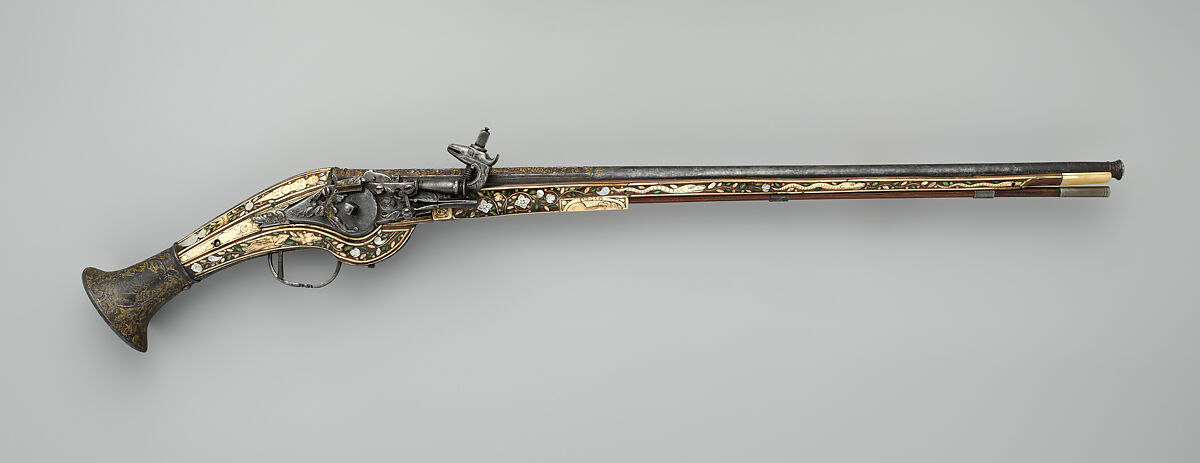
Wheellock Pistol, Steel, wood, staghorn, mother-of-pearl, gold, French 
 Credit: The Met

      By using the spirits literally inside these intricate works of art, they exploit a loophole that the spirits never see coming. This means that firearms, while available in the setting, remain expensive and slow. They remain at this level because the real world progression of firearms, such as flintlock, percussion caps, cartridges, and casings, is less viable, because it's more about tricking the spirit than making the gun easier to use. This also means that firearms are works of art first and weapons second, meaning that they are covered in ornamentation and over-designed, because the more this is clearly art, the tighter the loophole holds.

    Another problem I faced is that Hodas is mostly islands, with only a few large land masses, as determined by the players. This means there is a rich sailing culture and lots of pirates. Ship-to-ship combat in a world with black powder feels like it should have cannons. Any judge could just say, "No, I'm not including cannons," but that didn't feel good to me. Cannons can absolutely be a work of art.

r/totalwar - Fun fact: The Qing Dynasty actually used dragon-headed cannon. 

    So my solution here was to say, "Cannons that are also intricate enough to have the scaled-up wheellock and be a work of art are prohibitively expensive." This didn't answer what people used in ship-to-ship combat. I liked boarding because that is fun and gets the players into a fight, but it can't all be boarding. A world where sailing was as old as life had to have naval weapons. So I settled on cannons being rare, with smaller ones like swivel guns, large deck-mounted crossbows such as the Roman scorpion (often with a rope attached to drag the other ship into boarding range), or fire lances made by the setting's goblins, who are masters of alchemy. Adventurers will quickly learn that even a single Rampart Gun or Fire Lance can decide a boarding action. Pirates love cheap goblin fire lances despite the danger, while navies prize the rare Featherfolk cannons as prestige symbols.

     Where we really had fun was thinking about what interesting black powder weapons were out there that could be added into Hodas, allowing for a wheellock mechanism to keep it on theme. The short answer is: "Anything you want, it's your game." But when we look at Crawl #8, it covers what is important: pistol and rifle. Most things comfortably fall under one of those two as a simple blanket. So we wanted to get gonzo. We looked at stuff like the duckfoot pistol, the volley gun, and the blunderbuss to create some unique black powder options. Here is the list of what we came up with for Hodas:

Note: The variants and special weapons below should be hard to acquire. Not every gunsmith makes organ guns, but they might know someone they can send you to. Because each weapon needs to be a work of art, the larger or more complex the weapon, the more difficult it is to make, meaning that steps outside the norm of the pistol and rifle should be rare, with a few exceptions such as the blunderbuss.  

 Pistol: Unchanged from Crawl #8, always at least 100gp. These will be intricately etched and extremely detailed, making it likely they will be more expensive.

Rifle: Same as pistol

Blunderbuss: This gun, shorter than a rifle, longer than a pistol, and as accurate as neither, is flared at the end, making its shots scatter and loud. Often the end is carved with the maw of some creature; wolves and bears are popular, but different gunsmiths around the world will make different versions. When the blunderbuss is fired, any foe within 100 ft, with 4 int or less, and able to feel fear, must make a morale check or flee. The Judge will determine the DC of the morale check the foes must make. Optional: Judges may rule that when fired in a hallway or tight quarters, like those of a dungeon, this gun's range is reduced to a single 10-foot cone, with its attack rolled against all creatures in the cone, including allies.
Damage: d10; RoF: 1/3; speed -4; Range: 30/60/90; Ammo: 1; Weight: 10lbs; Cost: 150gp


Volleygun:  Typically used in naval battles, this gun resembles a collection of 7 barrels fused together, but is actually a single heavy piece. The volleygun is heavy and takes a long time to reload, an entire turn to pack and load with all its bullets and wind its wheel. They are mostly used in naval battles as an opening against boarders before being dropped and steel is drawn. They are rare among adventurers because they are heavy, and taking one into a dungeon often isn't worth the trouble. A volleygun's ammunition is fired all at once in a single attack. The person firing it makes 7 attacks, each one rolled using a d14 instead of the character's action die. They may fire at up to 7 targets, as long as they are all within 5 feet of the first target fired on. They are often decorated with swarm motifs, such as wasps or other stinging insects. Optional: cheaper and more expensive versions of this weapon exist with more or less barrels, up to 9 or as little as 3. each barrel below 7 removes 20gp from the cost of this weapon. each barrel above 7 adds 20 gp to the cost.
Damage: d8; RoF: 1/turn ; speed -4; Range: 80/160/240; Ammo: 3-9; Weight: 25lbs; Cost: 300gp
 
 
Duckfoot pistol: This strange-looking pistol resembles its namesake, bearing 4 barrels, none of which are pointed forward. Due to its unusual construction, it cannot be aimed and has an extremely short range. The tradeoff is that each barrel fires simultaneously, allowing the wielder to make a single attack against up to 4 targets that are within 5 feet of each other. Because of its complex loading mechanism, it takes 1 turn to reload and cannot be done in melee.
Damage: d8; RoF: 1/turn ; speed 0; Range: 10/20/30; Ammo: 4; Weight: 5lbs; Cost: 100gp 
 
Rampart Gun: Also known as swivel guns, these are massive weapons that need to be mounted or braced to be fired safely. They see a lot of use mounted on naval ships or ramparts. They hit hard and deal double damage to ships and structures they hit. Typically, these come already mounted to a surface and cannot be moved, but some adventurers have developed a large tripod which can be used to deploy the weapon anywhere, taking only one round to set up the tripod and ready the weapon. If a character attempts to shoulder-fire a rampart gun, they immediately take 1d6 damage and fall prone (only the extremely sturdy Minotaur may shoulder-fire this weapon without ill effect; Judges may rule that exceptionally strong characters can also shoulder-fire this weapon).
Damage: d12; RoF: 1/3 ; speed -4; Range: 90/180/270; Ammo: 1; Weight: 50lbs; Cost: 350gp

Pepperbox/Harmonica: Not an entirely unique weapon from the wheellock pistol or rifle, the pepperbox variant simply equips the existing pistol or rifle with a rotating barrel, which must be manually rotated, and allows the character to achieve a fire rate of 1 per round. The catch is that firing this each round agitates the earth spirits inside the powder, increasing the critical failure range by +1 for each round this weapon is fired without resting for at least one round. This modification can only be applied to the pistol or rifle. This can have anywhere from 3 to 6 barrels. The pepperbox variant with 3 barrels costs twice the price of the base firearm, and an additional 20 gp for each additional barrel.

Double Barreled: This is another variant of the standard pistol and rifle. A second barrel is added to the weapon, which allows it to be fired more than once before needing to be reloaded. This allows the wielder to either take one shot for two rounds without reloading or take two shots in a single round using the two-weapon fighting rules. The wielder cannot benefit from Aiming if they opt to fire two shots in a single round. This variant costs 50% more than the base weapon.

Goblin Fire Lance: Not a true firearm, but often used in their place on ships. the fire lance has a short range but projects a line of fire derived from a thick gel kept under pressure. the gel is put into a chamber and air is pumped into the chamber by hand in order to create pressure. the tip of the lance has a piece of rush, coated in animal fat to burn slowly but consistently, fixed to the tip. when the pressure is released the gel is sprayed out of the tip and ignites when it hits the burning rush, creating a horrifying spray of fire that clings to anything it hits and burns until smothered. the drawback of these weapons is that, unless the same goblin (or group of close goblins who have worked together for a long time) brews the gel, loads, and fires the lance, there is a 10% chance it will explode and cover the user in fire while causing them to take 1d10 damage from the explosion then 1d6 from the fire until they smother it (usually by jumping into the water). If the same goblin brews the gel, loads, and fires the cannon there is only a 1% chance of this happening each time it is fired. The fire lance releases a line of fire 80 feet long and deals 1d10 to anything in that line and lighting it on fire to deal 1d4 each round until the fire it put out. Because of how dangerous the fire gel is, even the goblins of Drebas won't use these weapons in city defense, at sea the fire can be smothered but on land you risk burning down your own city.

Organ Gun: More artillery piece than personal firearm, these weapons look like a pipe organ turned on it's side. consisting of 10 or more barrels designed to fire all at once, this is intended to be an anti-personnel weapon used against formations and crowds. These are unwieldy and massive, its extremely rare for an adventurer to use one due to its need to be towed and it's impracticality in dungeons and exploration. When this weapon's wheelock mechanism is triggered it deals its damage automatically to all creatures within a 60 foot cone. This weapon takes 1 turn to reload alone or 5 rounds to reload with a trained crew. value 500gp, Damage: 2d10 (Ref DC 15 for half)

Puckle Gun: A small, rapid-firing gun designed for naval conflict between Moyros and Drebas. Moyros found its large warships often coming into conflict with the small and fast war canoes of Drebas, and a naval gun that was small and maneuverable while able to fire rapidly was needed. These are exceptionally unwieldy, requiring a tripod mount and its swivel in order to be fired at all. Similar to the pepperbox, this weapon can fire 1 per round, but gains a cumulative +1 critical failure range for each round it is fired in a row. The chambers each take three rounds to reload, but a spare cylinder may be on hand to replace the spent one, taking 1 full round of no other actions to swap them out.
 Damage: d10; RoF: 1/round ; speed -5; Range: 90/180/270; Ammo: 9; Weight: 50lbs; Cost: 500gp
 
  Classes can use the above weapons as follows:
Warrior & Featherfolk: All
Thief: Duckfoot pistol, Pistol
Minotaur: Rifle, Rampart gun, Puckle Gun

    That about wraps up what firearms my players have encountered in Hodas so far. The setting doesn’t need to be locked into the black powder era, but that's where I'm comfortable. The players have already introduced tube-fed weapons in the form of a shotgun, due to a mercurial magic effect switching them with people in the modern era for a few rounds, and the setting's gunsmith guilds quickly purchased that weapon and buried it out of fear. Maybe the loophole can be twisted further. Maybe clockwork minds will marry gears to wheellocks. Or maybe the spirits themselves will rebel. For now, black powder remains as much art as weapon and that means it’s always a little dangerous.