Showing posts with label Rules. Show all posts

Tuesday, May 26, 2026

Super Vehicle Rules

 Mentioned briefly in the Vigilante Class for Comic Crawl Classics or Evolved I now present the super vehicle rules. I didn't really care for the rules presented in Evolved and wanted them to be a little more granular and potentially tied to progression and player choices. I wanted something that felt a little bit like it could allow choices for unique vehicles as players built them differently. I also wanted to tie it to the prosperity die, which this project will be using, when getting points for upgrading because we always see the most wealthy of heroes with these insane vehicles and super suits. I wanted something that gave players options and wasn't just loaded with bonuses to X or Y all over the place. I wanted it to feel like comic book craziness where a vehicle could be built quickly and we could lean into the "rulings not rules" style that DCC lives and breathes.

    The rules I present below assume using the same vehicle rules as Evolved which originally got them from The Umerican Survival Guide. 

     As with the other posts in this series, this is just the draft of these and a fully corrected, edited, formatted, and fleshed out set of rules will be presented when the book comes out.


Super Vehicles

Thursday, March 12, 2026

Judge Toast House Rules Vol3

     Welcome to another post where I share a bunch of house rules that I use at my table. As always with these I'll Share the rule and talk a bit about why I use it and how it has worked out for us. Here is a link to Vol 2 if you're just joining us and wanna see more!


I know a guy: once per session a player may declare that they "know a guy". They are allowed to detail who this guy is, why it's relevant to what is happening right now, and what their connection to the person it. I will then roll 1d10. This is to determine the person's attitude towards the PC who knows them. a 1 is enemies, on sight conflict, and a 10 is good friends, lifelong allies. 
This is a good tool for allowing the players to have just a little more influence on the setting. I feel strongly about the games being a group storytelling activity and your character should know people outside of the party. This is how you show what kind of friends your character had or has. In play I've only ever see one person try to abuse it but naturally the Judge holds veto power over any NPC proposed, so it is an easy thing to keep from being abused.
  
Magical Feedback:  Wizard and similar casters start combat with a d4 in front of them, the "1" face indicated. Each round the wizard successfully casts a spell they increase this die by 1. This number is added to checks made by the wizard to cast spells. When this reaches a 4 the wizard suffers from magical feedback. They must make a roll-under check on their casting ability score or lose the ability to cast spells for 1d4 rounds. a pause of a single round resets this counter to 1. When this is at 4 and the wizard has successfully saved, it remains at 4 and a new check must be made each round they cast a spell.
This is another that comes directly from the Index Card RPG. I really love that book and feel that even if you don't play it, you will find something to take back to your table. Strongly recommend reading it. I really like this as just one extra little way a wizard can get spells off but also maybe dig too deep into the power they utilize and be left with nothing for a short time. This one I've really only used at a physical table but I really liked it when it was at our table.
 
Signature Spell: After a wizard determines their spell list, they then select one spell from that list to be their signature spell. Each time they cast this spell they add double their level to the check. Each level after 1st, they may add another spell to their signature spell list but may never select a spell that they have only just gained, it has to be a spell they have had before gaining the level. they cannot double select a signature spell.
This has always mostly served as a way to give the wizard just a little more juice, a way to tilt things in their favor on at least one spell early on. It also sort of lines up with a lot of appendix N, you see a lot of magic users in that who have spells they use over and over in favor of others. I don't find that it really changes much other than to add just a little more flavor to the character.
 
Research Spells: a wizard may have at any time 2 randomly determined "research spells". These spells are cast using a d14 instead of the usual d20. They also have 2 randomly determined mercurial effects. When a wizard gains a level they may automatically take one of their research spells as one of their new spells, selecting one of the mercurial effects and removing it and now casting it with the usual d20. A wizard may also gain access to these spells early through questing, repeated attempts to cast, or long research periods in down time. Finally, with one week of down time, doing no adventuring or exploring, a wizard may discard one of their research spells and randomly roll a new one.
This is a pretty recent addition to the rules and it hasn't seen a ton of play. When it did we had one guy who didn't cast one of his research spells ever but constantly failed to cast the second one and when he succeeded it usually came in clutch as he spell burned like crazy and borrowed some luck from a funny little kobold to get the spell off. It broadens the wizard's spells selections but doesn't make it easy on them. I like it a lot for this reason. It also means that there is a reason that the wizard somehow gains a new spell fully at each level. I know I took this from somewhere but I don't remember where I found it. If you know who did this first, please leave a comment below so I can credit them.
 
 Second Wind: Any warrior or warrior adjacent class may begin combat with a d4 in front of them with the one showing. Each round they remain fighting they increase the facing on this die by one. when they die reaches 4, at the end of that round they may roll it and recover that many hit points, then reset it to one.
This is such a small amount of healing that it doesn't feel like it changes much but does allow a warrior to feel like a bad ass who is doing things like ripping off their shirt to bandage on the fly. It feels cinematic. This is yet another lifted right from the Index Card RPG (really, check it out!) and I've found that when I play in person it really encourages the warrior to play a little recklessly to try and get that extra little healing.
 
Change to mighty deeds: A warrior (and at my table only the human warrior) may choose three of the following things to apply their deed die roll to:
  • Attack Damage
  • Attack Roll
  • AC
  • Saves
  • Damage ignored this round
  • additional attacks: one additional attack for each time the number on the deed die is divisible by 3, rounded down, minimum 0.
These must be selected before the die is rolled and failure to indicate means the deed die only applies to attack and damage, as the rule book dictates. 
This one I'm pretty sure came from Knights in the North, like a lot of the house rules I use today. So I said this one was only for the warrior at my table because humans in my setting are sort of rare. There are a few race-as-class options that gain a deed die and are their own version of warriors. So this is only for the human warrior to make them stand out just a little more but in the past I have allowed it for the non-human deed having classes and it works out just fine.


    Well, That is another pack of my house rules. I think there might be one more volume of this where maybe I include a PDF with all of them together, kinda like how Judge AMP did over on Knights in the North. I Find that most of my house rules have integrated pretty seamlessly into the games I run and aren't often missed or forgotten. I generally approach with a philosophy of "does this make someone have more fun?" rather than "does this balance the game?" or "does this solve an existing problem?". I find that a rulings, not rules, approach deals with those other two questions a lot better than making a house rule for every little thing that comes up.
    As always, Thanks for reading and I hope I gave you something to think about or take back to your table, if nothing else I hope you enjoyed reading! 

Tuesday, March 10, 2026

B-Team Adventures

     One of the things I like to do when I run a game is have the players play only a single character at a time with a few backup characters as the "B-team". In order to allow the B-team to sort of keep up with the party they gain an amount of experience based on the session number rounded down. This cannot exceed the experience gained by the main party that week. The question has often come up, "What was the b-team doing this week?" and I haven't really had a good answer. Until now. Now I have a table to roll on when asked what they were doing that lends itself to making up threads for the party to pull on if they want to or simple storytelling if they don't. Check it out!


B-Team Adventures! 

Tuesday, January 13, 2026

Monster, Lairs, and Battles

Lair Actions
    Something I really love that 5th edition D&D did was lair actions and legendary actions. For those of you unfamiliar with them lair actions are special actions the monsters can take within their own lair, such as making part of a cave collapse. Legendary actions are given to those monsters and foes who are a cut above, used to signify bosses of adventures, these are actions that allow them to act slightly out of initiative order to do a short list of things. I always thought these rules were fun and really lined up with the DCC philosophy of "monsters don't follow the rules", stated in the monster section of the rule book. Giving them these options contributes to making them mysterious and frightening. 

    In general my players have been smart and careful enough to avoid fights with monsters in their own lairs, luring them out, baiting them to another location, or simply destroying the lair before starting a fight. So I've never been able to really use lair actions in DCC until very recently. I gotta say it was a great time. The players fought an evil magician with his scarecrow minions. They went in supremely confident that they could trash this guy... and then he activated every scarecrow in the room for a free extra round of actions from them and the players immediately realized the danger they were in. It totally changed how the battle felt. It went from confident magician stomping to panic and filling the room with smoke and fire in a single round. Had they baited this magician out of his keep he wouldn't have been able to do this. 

    This really felt like it added something, everyone remarked that the fight was a lot of fun and despite things going sideways quickly they were having a good time. This is something that I really think fits into the philosophy of DCC and to make it lean further into DCC we could go as far as making it's lair action into something it rolls on a table to determine it's random lair action. Even a short d6 table could really make the  concept of a lair action lean into the identity of DCC more than it already does.


Legendary actions

    In truth, I've not had the chance to use this. If I'm being totally honest, I keep forgetting. The way I run is a lot of improv and off the cuff, so as a general rule, I don't have set stat blocks ready to go. I borrow from things I've read, I improvise in the moment, I copy something close enough. For something like these Legendary Actions, my style of running is really bad at having those. So I cant speak to this as anything resembling an authority. However, this feels like the philosophy of DCC. Giving a big powerful threat these special things that allow it to break the rules just a little lines up with that "monsters don't follow the rules" line. It also does something to make the monster or foe more dangerous while giving them complexity instead of just bumping up the numbers. In theory, if you were to lift it 1:1 from 5e you could make a whole lot of panic happen at your table when a character spell burns like crazy to do something devastating and the foe uses one of these legendary actions to resist it. I think there is a discussion to be had here over this one and I am open to that discussion.


 Windup Attacks

    A D&D youtuber who has been playing since the old days did a video about this, Telegraphed Attacks and that is where the idea came from for me. I've used it once or twice and always to great effect. The idea is simple, we've all played a game where the bad guy winds up for an easily avoided attack, you dodge and come back swinging. At the table this creates an environment of risk and weighing options. Maybe you know your friend already spent their round in the attack range and you need to decide if you're going to get yourself or them out of the way. Maybe you think you can bring down the foe before he brings down his huge sword? Failure to get out of the way of such a big and telegraphed attack should be punished. It should be crippling, an automatic critical, or some other effect applied to the characters who didn't escape the incoming attack. I've used this to have the battlefield suddenly altered, characters sent flying, and weapons and armor broken. It changes the flow of combat, no one wants to find out what happens when the ogre swinging a battering ram like a club connects that windup hit. It doesn't need a map either. If you're like me and handle your fights in a theater of the mind, its easy enough to explain that the foe is winding up an attack and you are in the range of people to be hit. 


I know this was a bit of a short one, I just really wanted to share this. This is one of those things that I found and liked while playing another system. Yes, DCC is my home system and the game I use to run almost everything these days. But experiencing playing other systems, even for a short time, is important. Even when I hate a system, there is still something somewhere in there, a small treasure to plunder and take back to my home system, something to enshrine on the shelf and make my home system just a little more personal. 

Thursday, January 1, 2026

Judge Toast House Rules Vol2

     If you've been reading my blog for a while you know I love house rules. I love that every table has their own rules they run by. It creates such a diverse ecosystem in DCC. No two tables seem to be the same and I think that is something really special about this game.

    So this week I'm gonna offer up a few more of the house rules at my table. For those interested, here is the first part of the post: House Rules Vol 1. Keep in mind that these are general rules, I have others specifically for classes and those will definitely be in future installments of this series.


Fellowship:
This is talked about in This post. Keeping it short, at the end of each session I have the players award each other a few experience points. They have to say why they are giving these points out, even if it's as simple as "I'm glad you made it today". This is a small amount, usually each player has a number of points equal to the number of players and cannot award themselves any.
 
This has a whole story behind it that is told in the original post, so I'll keep this one brief. This came about as a way to get the players to really pay attention to each other's actions in the game. It gets them invested, they are looking for those moments where they can award other players. 
 
Permanent Injuries:
Pulled from the pages of D.A.M.N. (at this time I am unable to find a link directly to the zine so here is a review), I like to use the permanent injury table presented there. When a body is rolled over successfully, a point is not deducted from an ability score but instead they roll on the table and take the permanent injury.
I love this one because a point of ability score damage isn't all that interesting to me. Yes, you lost a point and something happened... but what happened? Do you have a limp? Are you an inch shorter? Is a nerve pinched in your shoulder? This tells a bit more of a story and has the added bonus of getting my players to actively seek out means to fix these issues. They hate to find out that they won't be able to sit comfortably in the tavern anymore, or that riding a horse will cause them painful discomfort and will seek out means to correct this. So it's not just an injury table, it's a push to adventure.
 
Infravision:
Infravision is explicitly the ability to see heat signatures in the dark. Just like with thermal vision, details are limited but fresh footprints do leave lingering heat for a few moments.
This is not explicitly a house rule, as the book explains it but not clearly. In the Elf, Dwarf, and Halfling section it mentions that these races have Infravision but only says they can see in the dark out to their given distances. Later, in the corruption section we see a clarification that this allows the sight of heat signatures. I always made this assumption because I'm a bit of an old school guy, I handled it the same way older editions of D&D did. This is more of a clarification than a real house rule but it is still on my list because it's often forgotten.
 
Martial Arts:
Similar to how anyone can (in theory) benefit from a patron bond but wizards and clerics get the most mileage out of it, we have martial arts. This means that anyone with access to a teacher, time, and money, can learn a new way to fight and push them to new heights. Each martial art has a base option and "spells" similar to a patron bond that you do not get right away.
This one is mostly because I just really liked it. The idea of warriors having their own sort of patron bond just really hit with me. This can have as much or as little of an influence at your table as you want it to. The school of martial arts could have needs, it could issue quests for more training, just as a patron would. It has seen a little play at my table and when it comes up it performs exactly like you would expect calling on a patron would, it's big, it's flashy, and you take great risk showing off your school's secrets so brazenly.
 
  
Helmet Law & All Shields Must be Splintered:
Exactly as presented in the pages of Crawl #2, these allow players to take a critical to the helmet or shatter their shield to eat a hit.
These are at my table because they are fun and cinematic. Every now and then a player remembers they have the option and it turns the tide. Someone shatters their shield and it always seems to change the momentum of the battle. At my table at least, it feels like the tide turns when someone makes this desperate move, everyone locks in and it becomes a battle for desperate survival that causes the players and their characters to look just a little harder at the fight and find a way out. 
 
Battle Fury:
    The first time a character misses an attack each combat they are to take a d6 and place it down in front of them with the 1 facing up. This face on the die is added to their attack and damage rolls. Each time they miss they increase the number on the die to a maximum of 6. When they hit, this die is removed from in front of them until they miss again, beginning the process over again.
 This one is lifted directly from the Index Card RPG. I use it because while failure and difficulty is part of the fun of telling a story and the dice represent the uncertainty, no one likes it when you spend the whole session not getting to contribute in any way because you fail every attack, save, spell check, and check above a DC of 5. Yes, the dice tell the story and sometimes the story is that you had a lot of bad luck that session... but I personally don't enjoy sitting at a table, rolling my math rock, checking my numbers, find out I failed, and then continue to do this for 4-12 hours while everyone else gets to contribute directly to success in combat, skill checks, and spells. This from a Judge who thinks that failure can be interesting and fun, often more than success.
 
 Sleep Rating: 
Beginning at 1st level, characters roll a d10 and indicate the result on their sheet as their sleep rating. This represents how heavy of a sleeper they are. A 1 represents a character who is a heavy sleeper and a 10 is someone who sleeps so light it may cause complications. This is rolled when a noise that might disturb a character's sleep is made, rolling under your sleep rating means your character wakes up to the sound. The character is still woken normally by being actively woken up by another character or taking damage. Someone sneaking simply uses their roll as normal and sleep rating is not rolled against a sneak attempt, nor is it rolled when someone is sneaking unless they roll a 1.
This one is almost as old as my history with tabletop. It came from playing a game that didn't really have rules baked in for passively waking up from hearing something, much like DCC doesn't. I like to have a way to decide if the characters heard that unusual sound in the hallway and if it woke them up or not. 


That's it for round 2 of my house rules. A lot of these come from experiencing other systems and taking little pieces I found worked for me along the way. I really think it's always a good idea to read through other systems, maybe even take a short break from your usual game and try them out. You never know what gem you'll find in a rule book you wouldn't normally pick up. As always, this isn't me telling you how to run your own games or saying that my way it better or definitive, this is just what I do at my table and wanted to share.

Thursday, December 18, 2025

Judge Toast House Rules Vol1

     I wanted to talk a bit about house rules this week. Things I've picked up from other games or tables and integrated into my own game. This was spurred by someone asking for a document of my house rules to see what i do differently. I figured I could share the list in sections and talk a bit about why I use those rules. For this post I'm gonna cover about half of my general house rules, future installments will cover the rest of this section and rules that are more relevant to specific classes. 


General Rules:

Lore: as described in this post.
 
Not gonna go too much into this one as it's in the middle of a re-write. The reason I have a rule for this at all is because I like magic items to be mysterious. Characters shouldn't pick up a sword and instantly know the name and powers of it. They should have to use it or study it, questing for information. Lore gives threads for characters to pull on to learn the specifics of a magic item they find, an avenue to quest for it.


Destiny changed: Upon reaching 1st level a character may choose to re-roll their birth auger on a different table, they must accept the new results
 
With this one I don't show the players the alternative table, I tell them that I'm not going to use the standard one in the book and that they must accept the results of the new table. This is a good chance for someone who has something that they won't really feel is relevant to them to have a second shot at their birth auger. This could represent a lot of things, usually I say this represents the character breaking from the mould and destiny of their old life as a turnip farmer to become an adventurer. If their stars don't change? well then it's clear this was always their destiny.


All babies are born lucky: All players have at least a +1 to their birth auger even if they would otherwise have a penalty. 
 
This is NOT an original from myself, I know I took it from someone but I couldn't tell you it's origin. I liked this because it mitigates situations where a guy who would otherwise make a decent warrior and nothing else suffers because he's got a -3 to hit or damage. 


Forged by fire: At each level, other than first level, players roll 3d6 and find the total. Any ability score they have that is below this total may be increased by +1.
 
DCC doesn't have built in stat increases, some people say Quest for it, other say it should be a part of the rewards for adventure. I actually agree with both of those but also think there is room for this.  This represents, just as levels do, a growth over time. These are people who are facing challenges day in and day out, it makes sense to me that they would have growth in unexpected ways.


God Calls: When a character is at death's door, usually hitting zero hit points or undertaking a task that will certainly kill them, they may reach out to any god they worship. This is similar to divine intervention but can only be used in this moment of death and is rolled on a d%. Characters have a base 1% per level, Clerics gain 5% per level, and paladins 10% per level. Players may write out their character's prayer or offer magical items to boost their roll. Things that modify this include if what you're asking for or attempting are within your god's portfolio, if the sacrifice is selfless, if the character has been shown to be devout, or if the prayer is relevant to the god.
 
This one is a bit of a relic from my days playing 2e. I adopted this from a DM I used to play under. It's been in every game I've run for decades now and it sees way more mileage in fantasy games than modern ones due to the prevalence of the gods. I think it really adds something and makes everyone rethink if their character has a relationship with a deity. suddenly the thief might actually think about if there is a god appropriate for their character to worship. A warrior might find a deity that resonates with them and actually carry out work for the faith.


EXP and encounters: Everything that uses up resources or presents challenge is an encounter. This one is covered pretty well under this post. I won't cover this one too much.


This is the first half of my general house rules, I don't expect anyone to take this as the word of law, it's just how I do things at my table. These rules won't work for every table and certainly wont fit well with the groups who lean more into sticking to the book as written, and to be clear I think this is a perfectly valid way to play the game. Everyone does things differently and I really feel like just how diverse tables are really says how good DCC is as a game.

Thursday, December 11, 2025

Shields in DCC


Shields in DCC are covered under simple rules, you do or don’t have a shield, it grants +1 to AC and a -1 check penalty. This is simple, this is elegant, this is good. There is nothing wrong with it and I think that for an overwhelming majority of games this is more than sufficient.


But...


We have so many other things about there for shields. A great many tables i’ve played at considered the rules from Crawl! #2 to be cannon and very important to the table, specifically the rule for Shattered shields and the expanded shields list. Its a great rule that adds something important and dramatic to the game. The shield list is fun, it gives us some fun new options. Without any additional prompting, the buckler is just strictly better than the normal shield because you can use it with a weapon in hand or with a ranged weapon but it costs 10gp more. 

I’ve played with a Judge who did something I really liked, he had some special rule for a volley of arrows with basically “get behind cover” and the guy with the normal shield was able to make himself small behind it but the guy with the buckler had to dive under a wagon. Mechanically, there is nothing there in the rules to support that. The Judge just made a call knowing a thing or two about the actual size of these shields and vaguely recalled old D&D 2e rules that talked about shield sizes and % chance for blocking ranged attacks, but he made a good “rulings, not rules” moment out of it I really liked this. It got absorbed into my games.

This really got me thinking, could homebrew for other types of shields be covered? Why not? Would it just make things needlessly complex? We have a brief line in the dwarf section about spikes or rounded edges on shields to deal more damage with a shield bash, so I kinda take that to be more or less covered. This is the big Strength of DCC, flavor it yourself. In it’s magic, in it’s classes, even in it’s equipment, flavor it yourself. I love this part of the game. Sometimes your warrior is a proper nobleman who is the typical chivalrous knight, sometimes they are a barbarian warlord, its just flavor you’re handling yourself without some mechanic getting in the way. So what could we do with shields to make them more nuanced? That's what I want to do here, list some alternatives to the standard round shield offering suggestions but not strict mechanics for them. So with no further rambling, here are some alternative options for shields.


Hungarian Targe:

This is essentially a buckler that runs the length of the forearm and then some, ending with a spike past the fist. This works by enhancing the natural shape of the arm and allows for use of a bow or second weapon, just like the buckler from crawl, while also being it’s own option for a two weapon fighting combination, should you choose to fight like that. It can be used with a two-handed weapon while still granting it’s AC bonus but isn’t going to be doing the user any favors against ranged attacks, not granting it’s AC bonus against ranged attacks.

Cost: 20gp, Bonus: +1, Check penalty -1

From: Wulflund


Leather or Rawhide:

This type of shield might seem like a bad idea on the surface, a steel weapon might punch right through it, right? Not always true. There are plenty of examples of these being used historically and in reality, you aren’t trying to go through your opponent’s shield but around it. Even a shield made of what could be perceived as lesser materials still serves it’s purpose. There are a lot of factors in this, such as the animal the hide came from, the methods used to make it into a shield, if it’s stuffed with anything and what with. We also have historical accounts of some of these leather shields stopping early black powder weapons. The other small advantage was that, if someone did get through your shield, their weapon is very likely now stuck and leaves them open to an attack. 

When used as part of a deed to disarm the user may choose to forgo their shield bonus in order to grant a +1 to their deed die. This shield cannot be used to block fire attacks, using it as part of your AC against flaming attacks will render the shield damaged beyond usability.

Cost: 40 gp, Bonus +1, check penalty +0

Medicine Shield via PittRivers Museum 


Nguni shield:

Another form of hide shield, these are lightweight and serve well to stop arrows and spears. They are tall and made with no armor in mind and are made to provide cover to a full body. Given the inspiration for these you might question how this could ever be useful against the kind of weapons present in DCC but I ask my readers to suspend disbelief for a world in which magic and the supernatural exist. This shield is often accompanied by a spike on one end of the staff used to support it. They work best in formations and are often painted in colors and patterns to designate the unit, company, or rank. 

This shield is best in the hands of someone unarmored using just this shield. But an armored user may still use this shield with diminished results. It is too large to be used on horseback.

Cost: 40gp, Bonus +2 (armored)/ +4 (unarmored), Check penalty -4 (armored) -0 (unarmored)

Nguni Shield via Internet Archive


Pavise (Archer’s Shield):

This is less of a shield and more of a personal deploy-able fortification. This is a large, usually wooden, shield that is planted in the ground and braced, providing cover to archers and crossbowmen to fire over and around. These cannot be used in an arm or in melee, it’s bonus only applies against ranged attacks from the direction it’s facing, for this reason they aren’t seen often outside of battles but use cases can be made for them for adventurers. In settings with black powder weapons we might see versions of this where there is an opening for sliding the weapon through without ever stepping out from behind the shield and some kind of metal plate with holes punched to allow sighting the shot.

Cost: 20gp, Bonus +6, check penalty: N/A


Pavis shield User:Julo - Ugo Pozzati, CC BY-SA 3.0, Link 


Shield Sconce:

This isn’t a shield but a torch sconce with straps on it to allow for shields to hold a torch. This is a specialist tool that should be hard to come by due to it’s niche use among adventurers. When this is strapped to a shield a character may plug their torch into the sconce and have a torch and shield in the same hand. The drawback is that if the shield is used in defense while the torch is attached, the torch will go out. 

Cost: 25gp


These few options by no means commit to the list of possible shields, of which history has thousands. Do all of them need to be accounted for? No, the rules of DCC covered shields well enough in my opinion. Did the shields I listed need to be accounted for? Also no, I’m just a guy posting about things he’s done at his table to shake things up a little bit. The DCC rules cover most shields well enough, just the occasional oddity is just fun to think about. You want a targe? Get a buckler and give it a spike. Covered under the DCC and Crawl rules cleanly. You want a kite shield? Standard shield. You want a round wooden shield, standard shield. You want the roman legionary shield? Tower shield. It can be as simple as you want it to be and should only ever be as complex as you want. 

Thursday, November 27, 2025

Lore: Identify magic and obscure arcana

     The core rulebook doesn't have a lot of information on identifying magic items your PCs might find. I've seen more than a few people take a crack at this, Over on Archade's Tower there is a great system for it that ties it directly to the item in some way and I've really considered including a roll on that table in my various magic item entries.

    I like magic items to be mysterious, the players pick up a unique looking sword, how should they know it's magical and not just a decorative sword or a noble's weapon? For this I use "Omens", minor magical properties that give no benefit but tell you that there is something unusual about this thing you picked up.

     Once they see the omen and know they have something magical how do they find out exactly what they have? There are a lot of ways to do this, the above linked article is a great example. There is also trial and error. If you spend enough time fighting with the magical dagger you picked up you will eventually learn its ins and outs, given that magic weapons usually have an intelligence score this is a good way to use this, as the PC uses it, the weapon reveals more of itself to the wielder... but that's dangerous, surely there is a safer way to do this?

    The system I adopted was called "Lore". Its based on a sub system of the first Baldur's Gate game in which your character has a score based on their class and intelligence modifier called their "Lore". The game is still a computer game and can't get too into it and have a ton of nuance but basically, if your lore is high enough you automatically know what a magic item is. I changed this up a little. For my games "Lore" only means you might have some information but not all of it. This represents the character's education and scraps they have picked up in their journey. Recall the part of lord of the rings where Gandalf sees the ring, leaves, spends weeks or months traveling and reading books to figure out exactly what that ring is. Your character might begin such a process because their lore score was high enough to recognize the magic item for what it is and know where to find more information on it. I prefer it this way because it leans more into the "Quest for it" side of DCC which is my bread and butter.

How does it work?

First your character determines their Lore value, using three things: their peasant profession, their intelligence score, and their class.

Peasant profession:
    The bonuses for this section aren't huge but it does make sense that a wizard's apprentice would possibly know a little more about something obscure than a turnip farmer. This is a one time bonus to the character's Lore. There are plenty of alternative profession tables out there and while I am just using the one presented in the book you could use this as a guideline to determine which bonus to give those alternative profession tables. Many of these are sort of determined arbitrarily so please feel free to alter this part to your heart's content. As a general rule, human professions use a base of +0, dwarves and halflings use a base of +1, and elves use a base of +2.
 
The following professions gain no bonus to lore:
 Beekeeper, Blacksmith, Butcher, Cheese Maker, Cooper, Ditch Digger, Farmer, Gong Farmer, Hunter, Miller/Baker, Orphan, Ostler, Ropemaker, Slave, Trapper, Wainwrite, Weaver, Woodcutter
 
The following professions gain a +1 to lore:
Animal trainer, Armorer, Caravan Guard, Cobbler, Costermonger, Cutpurse, Dwarven Herder, Dwarven Miner, Dwarven Mushroom Farmer, Fortune Teller, Grave Digger, Halfling Chicken Butcher, Halfling Dyer, Halfling Glovemaker, Halfing Haberdasher, Halfling Vagrant, Jewler, Locksmith, Outlaw, Soldier, Tax Collector, Urchin, 
 
The following professions gain a +2 to lore:
Barber, Confidence Artist, Dwarven Blacksmith, Dwarven Chestmaker, Dwarven Rat-catcher, Elven Forester, Elven Glassblower, Gambler, Guild Beggar, Halfling Moneylender, Halfling Trader, Healer, Herbalist, Indentured Servant, Mercenary, Merchant, Smuggler, Squire, 
 
The following professions gain a +3 to lore
Astrologer, Beadle, Dwarven Stonemason, Elven Artisan, Elven Falconer, Halfling Gypsy, Halfling Mariner, Jester, Noble, Shaman, 
 
The following professions gain a +4 to lore:
Alchemist, Elven Chandler, Elven Navigator, 
 
The following professions gain a +5 to lore: 
 Dwarven Apothecarist, Elven Sage, Mendicant, Minstrel, Scribe, Wizard's Apprentice, 
 
Intelligence:
A character's intelligence score has an influence on their lore, like the peasant profession, this applies a one time bonus. shown below:
1-6: -10
7-9: -5
10-14: +0 
15: +5
16: +7
17: +10
18: +15 
 
Class
This is divided into groups of classes to make the use of alternative classes easier. most classes will fall under at least one of these, some might fall under two or more and you, as a judge, should make a good faith decision on which is most accurate and fair. 
  • Fighting men: +3/level
    • Includes Warriors, Barbarians, Minotaur or other extremely martially focused or typically not learned classes such as the Kobold. 
  • Men of guile: +5/level
    •   Includes the Thief, Halfling, Prowler, or similarly clever but not well educated class. 
  • Men of faith: +7/level 
    • Includes the cleric, the Mountainborn, the Dervish, or the Icon bearer, these are typically people who have had some form of formal education in a temple or something similar.
  • Long lived ones: +10/level
    •  includes Elves, Dwarves, Furies, and living weapons. 
  • Men of knowledge: +12/level
    •  includes the wizard, the Goblin or the Leech. These are people who's class represents someone who's knowledge base includes passing familiarity with obscure arcana.
  • Scholars: +15/level 
    • includes Bards, Balladeers and Sages. These are people who's lives have been spent collecting and learning the most obscure pieces of information


 Once a player knows their PC's Lore, they note it on the sheet and when they encounter obscure arcana or magic items, assign those items and information a Lore value, anyone who has a Lore Value high enough will get a few crumbs of information to follow up on and seek out more information on the item or arcana in particular. Not everything should have a Lore value, just the most obscure things or one of a kind magic items (which should be most or all of them). 

I hope this is useful, it's certainly been helpful at my table and given my players quite a bit of guidance for the directions of their quests and adventures and hopefully it will give your players some threads to pull on too!

Thursday, October 30, 2025

Mercenary Company Generator

     For one of my player's backgrounds after coming out of the tomb of level up one of my players was a mercenary in the time between level 0 and level 1, this is how his character got his training as a warrior. I wanted to generate the name and banner and other details of the company and have something I could use in the future for similar cases.

    I was influenced by Metal Gods of Ur-Hadad's gang generation tables, the idea being that you roll all the dice and move through the tables. So I went ahead and made one for mercenary companies. This worked well for my setting because Mercenaries are alive and well in the setting, used in proxy battles and skirmishes to make sure the city-states have plausible deniability. 

 Mercenary Company Generator 

Thursday, October 9, 2025

Ritual Magic and extra spellcaster options

     Playing a wizard in DCC can be brutal. At first level you're packing darn near a 50% failure rate on your magic. Tack on that you probably aren't wearing armor and you're likely not the strongest or most agile person in your party's lineup and a lot of your early levels are spent ducking for cover or shooting a bow into combat. At these levels you might question why you took this class while the rockstar of a warrior is doling out deeds and the thief is opening a lot of fights with critical hits. Wizards have the mechanic of spellburn to support them at early levels, and this can certainly help, but the trade off is that if you use it too much you become dead weight to the party. meanwhile the warrior, cleric, and thief can slug it out in melee and then have their hp recovered with a few lay on hands. for a lot of people, myself included, it feels like the wizard's thing is that they get one big spell every few sessions. To me, that doesn't feel great. It feels like playing the wizard means you get to do one big spell every now and then and spend the next few sessions being carted around in a wheelbarrow. What I want to offer in this post is a way for wizards to just eek out a little bit more of an edge that stops them from losing spells constantly and turning themselves into a mummy to be allowed to cast in the first place.

Art by: Lex Cazimi


Rituals
    The DCCRPG offers one such solution called ritual magic on page 124. This section details a lot of cool things, sacrifice, circles of mages, extended casting times, automatic corruption, and rare ingredients. It feels pretty complete and flavorful. It also feels like a lot of things that aren't relevant to an adventuring wizard. On that list two of those things feel like something that an adventuring wizard could pull off easily: the automatic corruption, a great and flavorful option; the rare components, which an adventuring wizard should be drowning in... in theory. Over the years, at my table, listening to tales of other tables, and listening to live plays I've found that these are often forgotten or overlooked because detailing what you rip off monsters and carry around is kinda a pain.
 
    What if we re-defined how rituals worked? Let us say that you can make the appropriate sacrifices, but the appropriate incense, and spend days fasting while preparing the spell and then not have it immediately go off? What I am suggesting is that wizards should be allowed to do work to gain bonuses to their spells ahead of time and then use that bonus later. A single ritual that cannot be added to or bonus altered until the spell is cast. Performing another ritual doesn't give you a new bonus, it just wastes time and resources.
 
Ley Lines
    Ley lines are energy that supposedly flows through mystically important places or places with dense population. These lines of energy are living, they are made up of the same baseline of magical energy that exists within all living things. By spending 1 turn studying the ley line energy in a place a wizard may roll a d20. on a result other than a 1, they gain +1d3 to all spell checks for the next 24 hours. on the result of a 1, they still roll the d3 but subtract that from checks. These ley lines are alive, maybe not in the way you or I understand life, but they do live and they might not like being used as a source. Each consecutive day a wizard draws on the ley lines as a source their chance of failure increases by +1. If a wizard uses the ley lines for 3 days in a row then they risk angering them on a 1-3 on the d20, instead of 1.
 
Extended Casting Time
    This one just outright disagrees with what the book says but I think that the best thing about DCC is that it's so easily home brewed. Under my rules and at my table, a spellcaster may extend the casting time of a spell by the same increment that it normally follows. for example if a spell has a casting time of one action, a character can use their additional actions, including their movement, to add their level modifier a number of times equal to the number of times they extended the casting. For example, if a level 1wizard casts magic missile, which takes 1 action to cast, and spends the entire round doing nothing but casting that spell, giving up their movement, they would add +2, once for being first level and a second time for spending their other action. Lets say they spend the entire next round building up power, this would be a +4 when they release it at the end of the second round. Once power is built in a spell then the wizard must cast it, they cannot hold onto it forever. 
    I like this because it makes the extended casting time viable to an adventuring wizard and gives low level wizards a way to mitigate some of the failure chance without dumping their (likely already low) stats into nothing. This certainly has a flaw, a wizard could just declare at any point "I start to build power for this spell" and then send it off. It's certainly a flaw and requires good judgement and trust that it won't be abused. A penalty to avoid this could be introduced, such as building up more than a +10 to a spell causes corruption or hp damage.
 
Signature Spells
    This one feels like the bread and butter of my table to make wizards feel good. What this means is wizards, goblins, elves and other non divine spell casters select one of their spells which they are better at casting that the rest of their spells. The caster adds their level + ability mod x 2. at each level they gain one additional signature spell from the list of spells they could cast before leveling up. this signature spell cannot be selected from a new spell the character just gained on level up.
Alternative Signature spell: I've seen someone do something similar to the Signature spell but it would be cast at +1d, gaining +1d at each level, up to a d30. once they have a spell being cast using a  d30, they pick up a second signature spell that starts to increase, granting them a second signature spell.
 
Arcane Feedback
    This one is lifted directly from The Index card RPG but works really well for DCC. It just means that a wizard places a d4 in front of them with the 1 facing up. This is added to their spellcasting checks. Each round that they successfully cast a spell they increase the number on the die. once it reaches 4 and they have cast a spell with this +4 bonus they make a roll under check on their spellcasting ability or lose the ability to cast spells for 1d4 rounds. Alternatively you can make them suffer a corruption on a failure.
    I really like this one because it really doesn't matter that much to a really high level wizard but bolsters a low level wizard and encourages them to cast early and often with a small boost to their spell checks.
 
Sacrifice
    The book already covers this one and it doesn't feel like something an adventurers have ready access to. It grants +1 per 5 HD of the creature sacrificed. I think this is fun and interesting but what if that sacrifice is willing? In the netflix version of The Witcher we get this cool scene where one of the mages has a person step up, get sacrificed, and turned into a massive fireball which makes all the other mages gasp in horror. To me, this sounds like something that a wizard might be able to do (maybe after researching a specific version of their spell?) to bolster their own spells. A willing sacrifice might even be worth a bigger bonus than an unwilling one?      
 
Familiars
    One last thing, every wizard gets a familiar. Familiars are fun, they are interesting, they are sources of potential struggle and danger. I know we have a spell called find familiar and the book isn't 100% clear on if a wizard starts play with one. I've seen people say that they have to take the spell, I've seen people say they just get it. It's one of those things that is interpreted differently by different judges. At my table, every wizard starts with a familiar.
 

 Wizards in DCC are meant to feel like they are brimming with barely contained power they don't fully control. They aren't meant to feel safe and stable. I feel like this is why we have corruption, misfires, and mercurial magic. It makes sense that casting is difficult at low levels, the wizard just started their career, but it doesn't feel good to blow your roll to cast all your spells and then stand around and watch everyone else wreck house. As always, let the dice fall where they may but maybe give the wizard a chance to have fun with everyone else at the table.

Tuesday, September 23, 2025

Let the Dice Fall Where They May

“Let the dice fall where they may” 

Few lines in the DCCRPG hit this hard to me; it’s simple, but it's a powerful philosophy of play. The section is short - it explains that you should let the dice dictate combat, and that the players will learn to fear and trust the objectivity of combat. It goes hand in hand with another phrase I love: “The dice tell the story.” I think the idea that the dice are ultimately the final arbiter of the tale is so important to games. I would like to talk for a bit about what that means to me and how I let my games live (and sometimes die) on this concept.

Players Roll All the Dice
    For starters, I don't roll dice at my table. I haven't for years now. I pick players and have them roll the dice for me in order around the table, out in the open. This does a lot of things to change how the game feels. When I tell a player, "Bad guy is attacking you. Would you like to roll against yourself, or pass it on to the next player?" it means that the player is now thinking about who's next to them. If they want to risk the roll against themselves when they feel they are on a hot streak that night. If they want the next guy over, who has rolled and killed more PCs at the table than anyone else, to be the one to roll the dice. Sometimes the players all work together to pass until it gets to the guy who hasn't rolled above a 5 all night. It creates a little game within the game. More importantly, it keeps everyone's focus on the table. At any moment you could be asked to roll an attack, damage, save, check, anything for one of the bad guys or NPCs. Similar to Popcorn initiative, this keeps everyone paying attention. I won't pretend to be the only person who has the players roll dice for me or even the creator of it, because I myself got it from a guy I played with back in the early 2000s. What I will say is that I think more Judges should do it.


Trust Through Transparency
Another great way this changes the game is that it means players will have so much more trust in you as the Judge. There is no screen hiding your rolls, there are no secret numbers, no guessing if they really succeeded or failed, or if the bad guy really rolled several critical hits in a row. The dice are all out in the open, they can see what's happening. It's not just combat either - this applies to everything else that happens. The rolls the NPC makes to resist the charm spell? They see the result. They know what happened. The roll for the number of rounds until help arrives? They see it, they know how bad or good the situation really is, and they trust the story to unfold appropriately. This brings the table together with lighthearted jabs of "why did you make them resist my spell?" and "good thing you rolled low for his initiative, dude!" The table feels it more if they are rolling the dice instead of me secretly rolling behind a screen and telling them "oh yeah, help is 1 round away."


Judges Toolbox 
This might feel like it removes a lot of tools a Judge can use to keep things dynamic or the benefits of keeping things shrouded in mystery, but I offer that there are still ways to keep things close to your chest while doing this. You don't have to tell the players the bonuses to attack or saves or anything when you ask them to roll the dice. Sometimes I do, sometimes I don't; it keeps them on their toes to be a little inconsistent here. I don't always tell my players why they are rolling, I'll just say "hey, can you roll me a d20 and add 15?" It has a similar effect to rolling behind a screen but maybe even more. They hear that +15 and everyone starts to sweat about what on earth has that big bonus that they don't know about, even worse if the roll is also high. Some things I pretty much always tell the party are things like AC target numbers, because I think after a few rounds of combat they should be able to pin it down anyway, or I tell them the bonus of the attacks against them just to keep the flow of combat going smoother. Again, it's not every time; sometimes I like to keep the mystery to keep them on their toes.


The Power of Less Rolls 
Another great way to keep the dice as the important arbiter of the story is to use them less. That might sound contradictory, but hear me out. If you call for rolls less, the ones that happen will feel more important. The way I run at my table, I generally don't ask for rolls unless there is a significant penalty for failure. Anything I would put below a DC 5 generally doesn't get rolled. Weirdly, Kevin Siembieda of Palladium Games is a big influence on this one for me. His skill system is percent based, but he straight up says that if the players aren't being rushed, in danger, or on some kind of time crunch, don't make them roll. Pathfinder has something similar in the form of taking 10 or taking 20. Taking 10 is about taking the time to do something correctly; it can be done quickly, like in a single action, but you are following the old adage, "Slow is smooth, smooth is fast." Taking 20 is doing something over and over, failing many times until you get a 20, and it cannot be done quickly in a single round (unless you have the proper feat chains or class features, or something along those lines). The combination of these things has really colored how often I'm calling for rolls at my table. This gives a lot more weight to the dice when they are rolled. When they are rolled, the players know that it matters.

Some of my players read this blog, so I can't give away all the secrets I have behind the curtain, but there are a lot of ways to keep the same old Judge's tricks in your back pocket while doing this out in the open rolling and letting the dice tell the story. You just have to get a little creative with how you're applying those proven tools of a Judge. The other flaw in this is that we open ourselves to meta gaming. Players might be tempted to act on the information they know based on the open rolls. Meta gaming is a tough subject and talking about tackling that should be its own article. For now I will say that the trust needs to go both ways at the table for this to really shine. 


Prep, Chaos, and Style 
I'll also say that I know this isn't for everyone. I run a very fluid "rule of cool" table. I don't write down a ton of things about monsters and bad guys, I run very off the cuff, and I have a little notepad where I track numbers across combat and another where I take down fast session notes. My prep consists of vaguely recalling what was happening last week and consuming fantasy media for at least an hour before the session, and then diving in and running mostly off the cuff while using pre-written adventures occasionally or pulling things from other sources to have threats or rooms. I love pulling out one-page dungeons to have material. I'm sure a lot of Judges would call this method of prep chaotic, messy, and not at all helpful. I think that is fair. It's not for everyone. Even with this, I think this rule of letting the dice be the final arbiter and rolling in the open can be very good for a lot of tables, just not all of them. Remember, only you and your players really know and decide what works at your table, not some guy on a blog. But if you're interested maybe let your players roll against themselves or each other next session.
 

At the end of the day, the dice don’t just decide combat, they tell the story. When you trust them, and let your players trust them too, the table becomes a place where everyone shares in the suspense and the joy of whatever fate the dice decree.

Tuesday, September 9, 2025

Firearms in Hodas

This week I wanted to talk about firearms in my setting, Hodas. We use the rules presented in Crawl #8 to cover how they function and the rules for aiming and duels. If you're not interested in the body of the post talking about firearms in the setting, then scroll to the bottom for the stats on some alternative options for black powder weapons.

Notably, my setting is in the black powder era of firearms. This is because it's the tech level I wanted for them at this point, but also because a decision one of the players made locked us into the era. He decided that his chosen people, the race of bird people known as Featherfolk, would be the only people who could produce the black powder. Other races can create the weapons themselves, plenty of gunsmiths exist among the Goblins, Minotaur, Humans, and the odd Ooze but they can’t make the powder. You might ask why that is, because gunpowder is the kind of thing that shouldn't stay a secret; others would want that power. Well, when we built the world using Wasteland Without Epithet, he said black powder was their secret. I spent a long time thinking that one over: how on earth did they protect that secret? They are a people of shrewd contracts, but if someone decided to break a contract and face the penalties, then it could get out. Ultimately, I settled on something more flavorful to his chosen people.

    Matt said that the Featherfolk were a people of bureaucracy and contracts who even made contracts with the spirits they believed were in the world around them. So my solution was simple: the Featherfolk would create black powder by making a contract between simple earth and fire spirits, promising to use them in a work of art. They left the meaning of work of art ambiguous enough to create a loophole for themselves. The powder is loaded into one of these beautiful wheellock weapons:
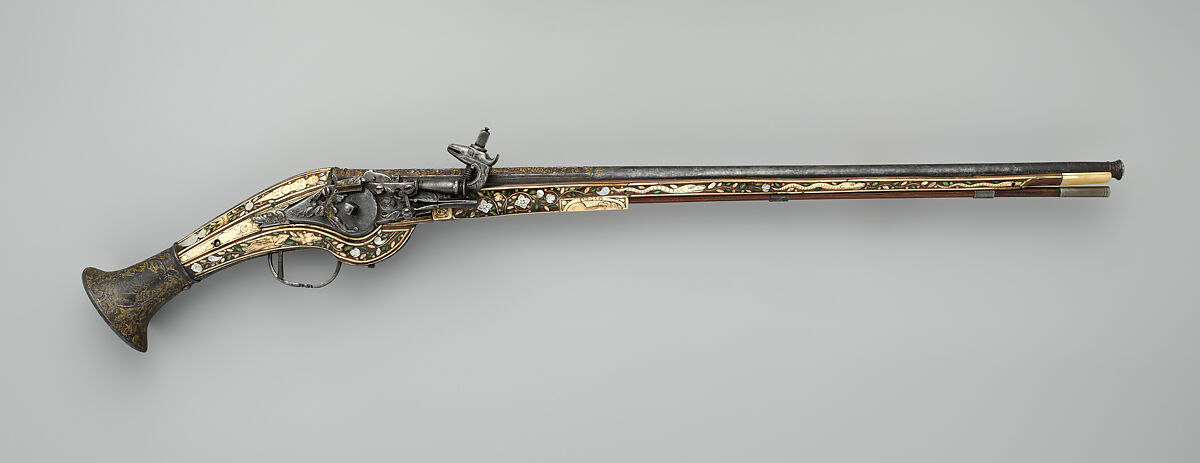
Wheellock Pistol, Steel, wood, staghorn, mother-of-pearl, gold, French 
 Credit: The Met

      By using the spirits literally inside these intricate works of art, they exploit a loophole that the spirits never see coming. This means that firearms, while available in the setting, remain expensive and slow. They remain at this level because the real world progression of firearms, such as flintlock, percussion caps, cartridges, and casings, is less viable, because it's more about tricking the spirit than making the gun easier to use. This also means that firearms are works of art first and weapons second, meaning that they are covered in ornamentation and over-designed, because the more this is clearly art, the tighter the loophole holds.

    Another problem I faced is that Hodas is mostly islands, with only a few large land masses, as determined by the players. This means there is a rich sailing culture and lots of pirates. Ship-to-ship combat in a world with black powder feels like it should have cannons. Any judge could just say, "No, I'm not including cannons," but that didn't feel good to me. Cannons can absolutely be a work of art.

r/totalwar - Fun fact: The Qing Dynasty actually used dragon-headed cannon. 

    So my solution here was to say, "Cannons that are also intricate enough to have the scaled-up wheellock and be a work of art are prohibitively expensive." This didn't answer what people used in ship-to-ship combat. I liked boarding because that is fun and gets the players into a fight, but it can't all be boarding. A world where sailing was as old as life had to have naval weapons. So I settled on cannons being rare, with smaller ones like swivel guns, large deck-mounted crossbows such as the Roman scorpion (often with a rope attached to drag the other ship into boarding range), or fire lances made by the setting's goblins, who are masters of alchemy. Adventurers will quickly learn that even a single Rampart Gun or Fire Lance can decide a boarding action. Pirates love cheap goblin fire lances despite the danger, while navies prize the rare Featherfolk cannons as prestige symbols.

     Where we really had fun was thinking about what interesting black powder weapons were out there that could be added into Hodas, allowing for a wheellock mechanism to keep it on theme. The short answer is: "Anything you want, it's your game." But when we look at Crawl #8, it covers what is important: pistol and rifle. Most things comfortably fall under one of those two as a simple blanket. So we wanted to get gonzo. We looked at stuff like the duckfoot pistol, the volley gun, and the blunderbuss to create some unique black powder options. Here is the list of what we came up with for Hodas:

Note: The variants and special weapons below should be hard to acquire. Not every gunsmith makes organ guns, but they might know someone they can send you to. Because each weapon needs to be a work of art, the larger or more complex the weapon, the more difficult it is to make, meaning that steps outside the norm of the pistol and rifle should be rare, with a few exceptions such as the blunderbuss.  

 Pistol: Unchanged from Crawl #8, always at least 100gp. These will be intricately etched and extremely detailed, making it likely they will be more expensive.

Rifle: Same as pistol

Blunderbuss: This gun, shorter than a rifle, longer than a pistol, and as accurate as neither, is flared at the end, making its shots scatter and loud. Often the end is carved with the maw of some creature; wolves and bears are popular, but different gunsmiths around the world will make different versions. When the blunderbuss is fired, any foe within 100 ft, with 4 int or less, and able to feel fear, must make a morale check or flee. The Judge will determine the DC of the morale check the foes must make. Optional: Judges may rule that when fired in a hallway or tight quarters, like those of a dungeon, this gun's range is reduced to a single 10-foot cone, with its attack rolled against all creatures in the cone, including allies.
Damage: d10; RoF: 1/3; speed -4; Range: 30/60/90; Ammo: 1; Weight: 10lbs; Cost: 150gp


Volleygun:  Typically used in naval battles, this gun resembles a collection of 7 barrels fused together, but is actually a single heavy piece. The volleygun is heavy and takes a long time to reload, an entire turn to pack and load with all its bullets and wind its wheel. They are mostly used in naval battles as an opening against boarders before being dropped and steel is drawn. They are rare among adventurers because they are heavy, and taking one into a dungeon often isn't worth the trouble. A volleygun's ammunition is fired all at once in a single attack. The person firing it makes 7 attacks, each one rolled using a d14 instead of the character's action die. They may fire at up to 7 targets, as long as they are all within 5 feet of the first target fired on. They are often decorated with swarm motifs, such as wasps or other stinging insects. Optional: cheaper and more expensive versions of this weapon exist with more or less barrels, up to 9 or as little as 3. each barrel below 7 removes 20gp from the cost of this weapon. each barrel above 7 adds 20 gp to the cost.
Damage: d8; RoF: 1/turn ; speed -4; Range: 80/160/240; Ammo: 3-9; Weight: 25lbs; Cost: 300gp
 
 
Duckfoot pistol: This strange-looking pistol resembles its namesake, bearing 4 barrels, none of which are pointed forward. Due to its unusual construction, it cannot be aimed and has an extremely short range. The tradeoff is that each barrel fires simultaneously, allowing the wielder to make a single attack against up to 4 targets that are within 5 feet of each other. Because of its complex loading mechanism, it takes 1 turn to reload and cannot be done in melee.
Damage: d8; RoF: 1/turn ; speed 0; Range: 10/20/30; Ammo: 4; Weight: 5lbs; Cost: 100gp 
 
Rampart Gun: Also known as swivel guns, these are massive weapons that need to be mounted or braced to be fired safely. They see a lot of use mounted on naval ships or ramparts. They hit hard and deal double damage to ships and structures they hit. Typically, these come already mounted to a surface and cannot be moved, but some adventurers have developed a large tripod which can be used to deploy the weapon anywhere, taking only one round to set up the tripod and ready the weapon. If a character attempts to shoulder-fire a rampart gun, they immediately take 1d6 damage and fall prone (only the extremely sturdy Minotaur may shoulder-fire this weapon without ill effect; Judges may rule that exceptionally strong characters can also shoulder-fire this weapon).
Damage: d12; RoF: 1/3 ; speed -4; Range: 90/180/270; Ammo: 1; Weight: 50lbs; Cost: 350gp

Pepperbox/Harmonica: Not an entirely unique weapon from the wheellock pistol or rifle, the pepperbox variant simply equips the existing pistol or rifle with a rotating barrel, which must be manually rotated, and allows the character to achieve a fire rate of 1 per round. The catch is that firing this each round agitates the earth spirits inside the powder, increasing the critical failure range by +1 for each round this weapon is fired without resting for at least one round. This modification can only be applied to the pistol or rifle. This can have anywhere from 3 to 6 barrels. The pepperbox variant with 3 barrels costs twice the price of the base firearm, and an additional 20 gp for each additional barrel.

Double Barreled: This is another variant of the standard pistol and rifle. A second barrel is added to the weapon, which allows it to be fired more than once before needing to be reloaded. This allows the wielder to either take one shot for two rounds without reloading or take two shots in a single round using the two-weapon fighting rules. The wielder cannot benefit from Aiming if they opt to fire two shots in a single round. This variant costs 50% more than the base weapon.

Goblin Fire Lance: Not a true firearm, but often used in their place on ships. the fire lance has a short range but projects a line of fire derived from a thick gel kept under pressure. the gel is put into a chamber and air is pumped into the chamber by hand in order to create pressure. the tip of the lance has a piece of rush, coated in animal fat to burn slowly but consistently, fixed to the tip. when the pressure is released the gel is sprayed out of the tip and ignites when it hits the burning rush, creating a horrifying spray of fire that clings to anything it hits and burns until smothered. the drawback of these weapons is that, unless the same goblin (or group of close goblins who have worked together for a long time) brews the gel, loads, and fires the lance, there is a 10% chance it will explode and cover the user in fire while causing them to take 1d10 damage from the explosion then 1d6 from the fire until they smother it (usually by jumping into the water). If the same goblin brews the gel, loads, and fires the cannon there is only a 1% chance of this happening each time it is fired. The fire lance releases a line of fire 80 feet long and deals 1d10 to anything in that line and lighting it on fire to deal 1d4 each round until the fire it put out. Because of how dangerous the fire gel is, even the goblins of Drebas won't use these weapons in city defense, at sea the fire can be smothered but on land you risk burning down your own city.

Organ Gun: More artillery piece than personal firearm, these weapons look like a pipe organ turned on it's side. consisting of 10 or more barrels designed to fire all at once, this is intended to be an anti-personnel weapon used against formations and crowds. These are unwieldy and massive, its extremely rare for an adventurer to use one due to its need to be towed and it's impracticality in dungeons and exploration. When this weapon's wheelock mechanism is triggered it deals its damage automatically to all creatures within a 60 foot cone. This weapon takes 1 turn to reload alone or 5 rounds to reload with a trained crew. value 500gp, Damage: 2d10 (Ref DC 15 for half)

Puckle Gun: A small, rapid-firing gun designed for naval conflict between Moyros and Drebas. Moyros found its large warships often coming into conflict with the small and fast war canoes of Drebas, and a naval gun that was small and maneuverable while able to fire rapidly was needed. These are exceptionally unwieldy, requiring a tripod mount and its swivel in order to be fired at all. Similar to the pepperbox, this weapon can fire 1 per round, but gains a cumulative +1 critical failure range for each round it is fired in a row. The chambers each take three rounds to reload, but a spare cylinder may be on hand to replace the spent one, taking 1 full round of no other actions to swap them out.
 Damage: d10; RoF: 1/round ; speed -5; Range: 90/180/270; Ammo: 9; Weight: 50lbs; Cost: 500gp
 
  Classes can use the above weapons as follows:
Warrior & Featherfolk: All
Thief: Duckfoot pistol, Pistol
Minotaur: Rifle, Rampart gun, Puckle Gun

    That about wraps up what firearms my players have encountered in Hodas so far. The setting doesn’t need to be locked into the black powder era, but that's where I'm comfortable. The players have already introduced tube-fed weapons in the form of a shotgun, due to a mercurial magic effect switching them with people in the modern era for a few rounds, and the setting's gunsmith guilds quickly purchased that weapon and buried it out of fear. Maybe the loophole can be twisted further. Maybe clockwork minds will marry gears to wheellocks. Or maybe the spirits themselves will rebel. For now, black powder remains as much art as weapon and that means it’s always a little dangerous.